more coming soon!
/
I'm working on some other projects as well right now, so I'm not ready to share a timeline for the full site to be active yet. That said, here are some hints at what to expect here:
- posts about the "why" and "how" of church-based ministry to people with special needs
- reviews of available resources (including books, curriculums, and other ministry tools)
- a page of online resources that might be helpful to you
- a page with links to the disability-related blogs I read regularly (some are ministry-related, some not; some are written by Christians, some aren't)
- a page that lays out what special needs ministry is and isn't all about
Who is welcome at your church?
/
Lee and I love leading special needs ministry for families at our church. I wrote this in our Christmas letter this year: "To say we have been blessed to serve in this way would be an understatement. The best description we can offer is this: it’s not really an effort but rather it’s like we’ve been offered a front row seat to watch (and be a part of) the work God is doing in the lives of these children and their families. To Him be the glory!"
And it's true.
A couple months ago, a Christianity Today blog post was titled Is Your Church Open to Autism? I didn't find the post until someone else linked to it on Facebook today. While it's a good post, it was the comments that really caught me.
As in, caught me like a solid punch to the gut.
It's painful to know that church is the hardest place to go for some families whose children have disabilities. No, not because of anger at God or because of any other theological differences. Church is tough because many churches aren't welcoming.
I don't think they do it on purpose. But if your church isn't proactively welcoming people with disabilities as part of your body of believers, then you're probably not welcoming to them. If your church doesn't have an answer if a parent calls the church asking what Sunday morning could look like for their child with special needs, then it's simply not a welcoming place. (The same goes for churches with no answer for what Sunday morning could look like for an adult with special needs.)
I haven't been able to find the research to back this up, but I've seen estimates that 75-90% of people with disabilities are unchurched in the US.
That's just not okay.
Consider this comment left on that blog post:
Christ didn't shy away from people with disabilities. He didn't avoid it because it was too hard. He saw in disability the opportunity for the works of God to be displayed.
I wish all churches saw that. I wish all churches preaching the Gospel were willing to communicate it in a meaningful way to those who don't fit a traditional mold of learning or behavior.
I'm glad to be working with our church to make that happen.
And I'm praying for other churches, that none preaching the Gospel would limit to whom that Gospel can be preached.
And it's true.
A couple months ago, a Christianity Today blog post was titled Is Your Church Open to Autism? I didn't find the post until someone else linked to it on Facebook today. While it's a good post, it was the comments that really caught me.
As in, caught me like a solid punch to the gut.
It's painful to know that church is the hardest place to go for some families whose children have disabilities. No, not because of anger at God or because of any other theological differences. Church is tough because many churches aren't welcoming.
I don't think they do it on purpose. But if your church isn't proactively welcoming people with disabilities as part of your body of believers, then you're probably not welcoming to them. If your church doesn't have an answer if a parent calls the church asking what Sunday morning could look like for their child with special needs, then it's simply not a welcoming place. (The same goes for churches with no answer for what Sunday morning could look like for an adult with special needs.)
I haven't been able to find the research to back this up, but I've seen estimates that 75-90% of people with disabilities are unchurched in the US.
That's just not okay.
Consider this comment left on that blog post:
The most difficult part of having a child with Down syndrome has been at church.It sounds like they are working to do something for children with special needs at that church, which is sadly more than a lot of churches do. But the phrases that grabbed me were "included in a meaningful way" and "[t]he church needs to communicate the gospel to her, too." Amen to both of those.
Although I go to a great church, they have ignored her special needs.
When she was a toddler, I was told that "she was to be treated like everyone else."
That was folly. If she had been treated like everyone else, she would have been in nursery until she was five, because she couldn't walk!
Now that she's older, she goes to the children's ministry for part of the time, but they don't require her to do what she needs to do. I walked into one activity where she was wandering and when her younger sister tried to get her to sit down, the leader said, "She's OK." She wasn't OK, and it wasn't OK for her to be wandering.
Our AWANA program has no adaptations for her, although the workers are working with me so she can make progress.
Even though she IS at church, she really isn't included in a meaningful way. It's as if she's a mascot or a pet, not a person with a soul. I read no where in my Bible that there's a special dispensation for people who were born with 47 chromosomes in every cell. The church needs to communicate the gospel to her, too. She CAN understand.
Why don't they?
Christ didn't shy away from people with disabilities. He didn't avoid it because it was too hard. He saw in disability the opportunity for the works of God to be displayed.
I wish all churches saw that. I wish all churches preaching the Gospel were willing to communicate it in a meaningful way to those who don't fit a traditional mold of learning or behavior.
I'm glad to be working with our church to make that happen.
And I'm praying for other churches, that none preaching the Gospel would limit to whom that Gospel can be preached.
favorite photography by my girl
/
Jocelyn loves taking my little point&shoot camera and using it to her heart's content. I'll probably have a post a week or so with her pictures because I love seeing the world through her eyes.
This one has to be my favorite so far, though.

This one has to be my favorite so far, though.

{taken as she looked up at the sky from the trail at the nature park}
the Christmas gift that made me cry
/
A gift arrived from my aunt in a big box marked "fragile," and I was intrigued. I always enjoy gifts from Aunt Anne, especially because they're always good but never predictable.
And I could not have predicted what was in the tomato box.

This nativity set was made by a friend of my grandmother and given to her the year that I was born.

She passed away when I was in elementary school. Before my grandfather's body succumbed to cancer a few years later, he gave it to my aunt.

She felt that it was time for it to be passed to the next generation.

I failed to take a picture of the full mantle with all the pieces before I carefully packed it up (oops!), so you'll have to wait until next year to see a complete shot of the entire intricate set.
I'm humbled to have been trusted with this precious part of family history, and one day I look forward to passing it on to the next generation, adding to the list of names and dates of owners recorded on the inside lid of the tomato box to document the set's history.
What tangible pieces of family history do you hope to pass to the next generation in your family?
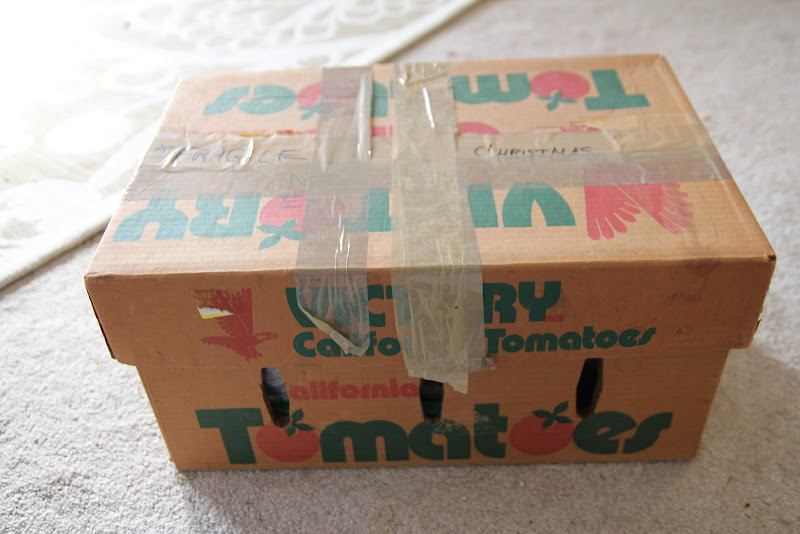
And I could not have predicted what was in the tomato box.

This nativity set was made by a friend of my grandmother and given to her the year that I was born.

She passed away when I was in elementary school. Before my grandfather's body succumbed to cancer a few years later, he gave it to my aunt.
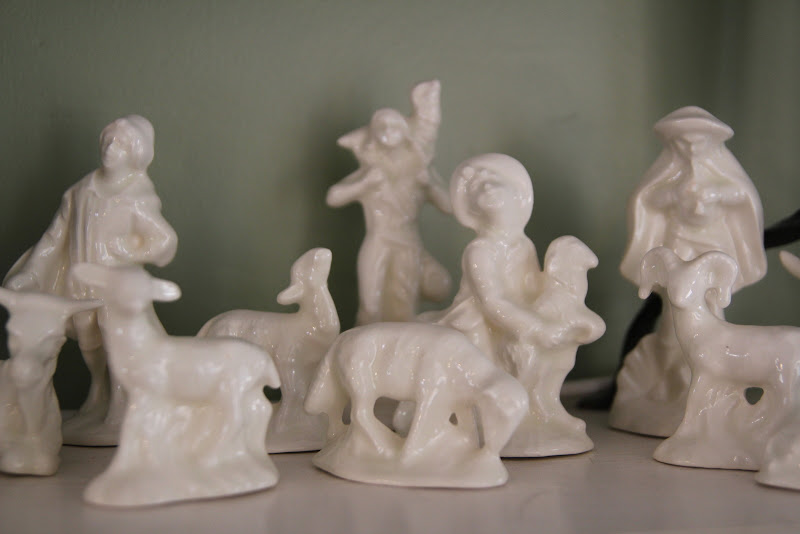
She felt that it was time for it to be passed to the next generation.

I failed to take a picture of the full mantle with all the pieces before I carefully packed it up (oops!), so you'll have to wait until next year to see a complete shot of the entire intricate set.
I'm humbled to have been trusted with this precious part of family history, and one day I look forward to passing it on to the next generation, adding to the list of names and dates of owners recorded on the inside lid of the tomato box to document the set's history.
What tangible pieces of family history do you hope to pass to the next generation in your family?
5He established a testimony in Jacob
and appointed a law in Israel,
which he commanded our fathers
to teach to their children,
6that the next generation might know them,
the children yet unborn,
and arise and tell them to their children,
7so that they should set their hope in God
and not forget the works of God,
but keep his commandments;
and appointed a law in Israel,
which he commanded our fathers
to teach to their children,
6that the next generation might know them,
the children yet unborn,
and arise and tell them to their children,
7so that they should set their hope in God
and not forget the works of God,
but keep his commandments;
8and that they should not be like their fathers,
a stubborn and rebellious generation,
a generation whose heart was not steadfast,
whose spirit was not faithful to God.
a stubborn and rebellious generation,
a generation whose heart was not steadfast,
whose spirit was not faithful to God.
Psalm 78:5-8