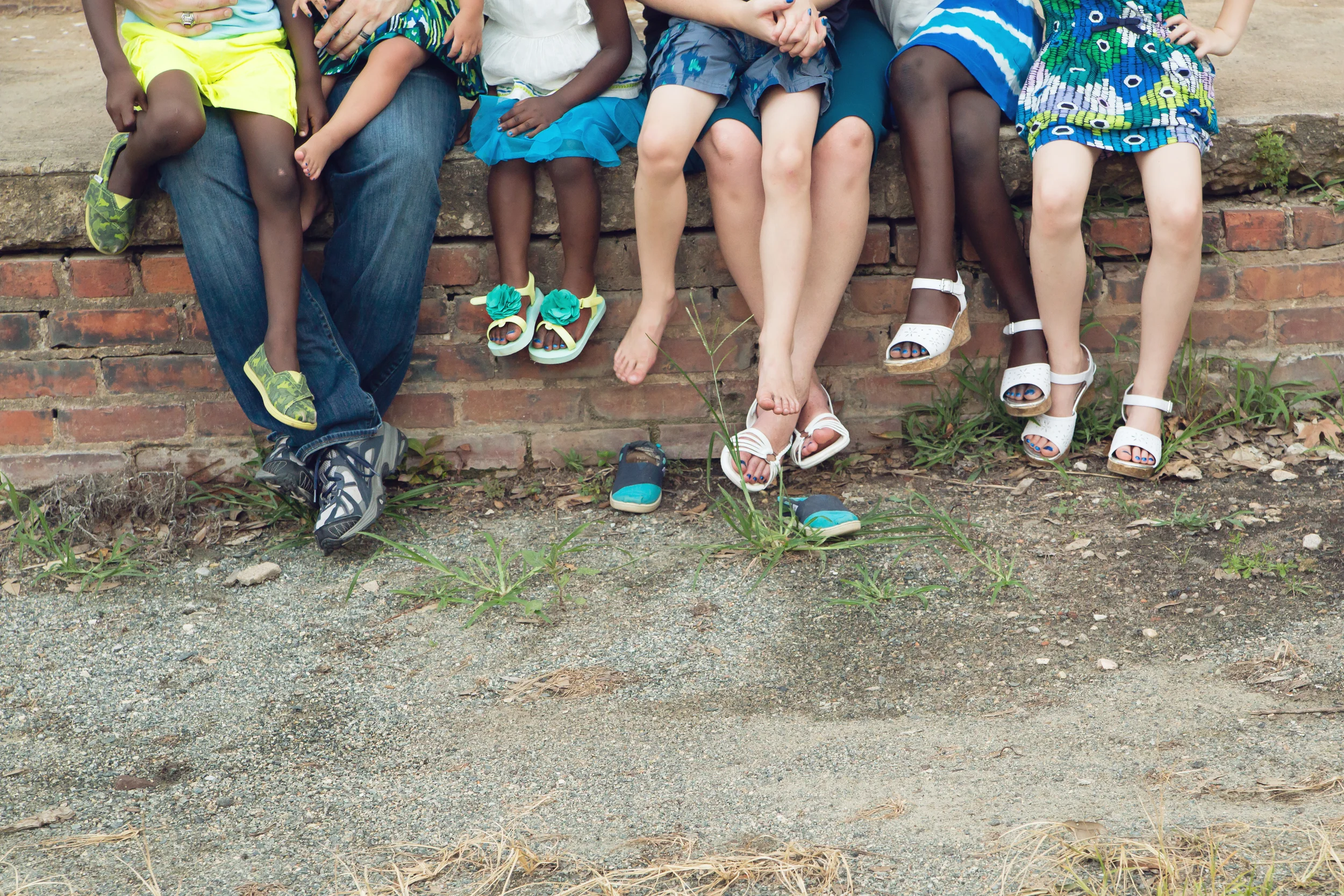
the post in which I convince you I'm crazy

I have mentioned adoption here before. I even included our intent to adopt in our family Christmas letter this year. I’ve just never provided a whole lot of details.

Because I usually don’t want people to think I’m crazy.

And usually adoption makes people think you’re a little crazy. We’ve gotten some of those looks. Even before revealing that we’re not planning to adopt a baby and we’re not planning to stop at one. You know the ones, the looks that people give you during your first pregnancy. The she has no idea what she’s getting herself into looks.

And I didn’t when I became a mom. No conversation or book or website or other resource could have adequately prepared me. It’s a lot of learning as you go with the guidance of others who have gone before you. And a lot of prayer. A whole lot of prayer.

So do we know what we’re getting ourselves into? No. Are we a little crazy? Yes. (But let's all be honest and admit that that’s going to be true whether or not we adopt.) Do we know what we’re getting ourselves into? Probably not. Scratch that. Definitely not.

Throughout the Bible, God calls His people to do seemingly crazy things in his name and for his glory. The whole send the Son of God to earth to live a perfect life and die to defeat sin and rise from the dead to defeat death plan is a little crazy. I mean, imagine if you had never heard the Gospel before and someone told you that. It's not exactly in the realm of logic.

I’m not putting us on the same level of Christ. Certainly not! We’re confident, though, that he’s leading us in this particular sort of crazy, though. And we wouldn’t want to turn our backs on him to embrace the ordinary.

We knew as a couple, even before Lee proposed, that we wanted to adopt. It’s a longer and more personal story than I have space for here, but feel free to ask me about it offline. We began reconsidering that after Jocelyn was born, leaning instead toward having more biological kids instead of adopting as many as we had planned. However, through a series of circumstances, God has brought our hearts back to where He led them in the first place.

After a lot of prayer and research and prayer and conversations and prayer, we're willing to share where we stand in our plans right now. No guarantees that it won’t change, though, because God does his thing (the best thing!) in his time. However, I don’t think it’s unwise to share our plans, just as others aren’t shy about saying “ideally we want two kids” (or one kid or five kids or no kids). We trust that God is sovereign, and we'll be content whether or not his plans are the same as ours.

But since you asked (well, no, I suppose you didn't. but it's my blog, so I can pretend you did):
  • We are very likely done with pregnancies. My body could do it, but I lost bone in my joints during my last pregnancy, ended up with MRSA (which recurred seven times and once led to c. diff), and – in many ways – could say that I spent four years recovering from my first pregnancy. So, unless Lee manages to bear a child for us, I don't think we'll be adding to our count of biological kiddos. I’ll confess that while we think this is the best choice for us, our hearts are a little broken. I might tear up sometimes when I hold a baby, because a part of me wishes I could hold another of mine. But my heart is full, nonetheless.
  • We expect to adopt our third child internationally through Reece’s Rainbow, an international Down syndrome orphan ministry. Yes, this means that our third child will have some degree of disability. (If you're thinking this makes us crazy, please refer back to the title of this post.) When we were pregnant with Jocelyn, Lee expressed concerns that she might have special needs because, in his words, “God knows you, Shannon. He knows that you would be a great mom of a child with a disability I just don’t know if I would make a great dad.” He’s not sure in hindsight if he meant “a great dad of a kid with special needs” or just “a great dad” in general. I can vouch for the latter that he is. And now, the same guy who was worried about having a child with special needs is equally or more passionate about adopting one as I am. It’s not a pity thing or a duty thing; as cheeseball as it sounds, it’s a God thing. In the US, a kid with special needs and without a family goes to foster care; it’s not a perfect system, but it’s not always a bad one either. In many other countries, an orphan with special needs – particularly obvious, definitive ones like Down syndrome – is sent to a warehouse called an institution and given little more than basic care. Often the extent of the disability is irrelevant. The idea of welcoming them into families is unheard of. (As a related update, Kirill – the Russian boy I told you about a couple months ago – is now part of the Davis family. I think they should be returning to Alabama next week.) We will begin that process in a year and a half to two years, once our third floor has been converted from all attic space to two bedrooms and a bathroom.
  • Our fourth and fifth children will likely be a sibling pair from the foster care system. The oldest will probably be in elementary school. We are planning for them to be the youngest children in our family, so that adoption is further down the road considering that our current children are two and four. From the beginning of our conversations about adoption, our hearts were drawn toward older kids. I think it’s wonderful to adopt a child of any age, though, and I wouldn't turn away an infant if the stork dropped one on our doorstep. (What? That's not how it works? hmm.) That's just not the age group we're planning to pursue.
We have some other crazy plans, like our intent to stay in our home until we die (assuming God doesn’t move us out of Raleigh); based on our current payment schedule, that would make us mortgage free in a little more than a decade, but that’s not our only reason. It is cool to think about how we could invest that extra money in God's work, though!

I think I’ll leave the rest of the crazy for another time, though. If you can get past our insanity, would you pray for us?

Thanks.

Words. They matter.

Last month, my church hosted a large women's conference. We put it on every other year, and it is truly a blessing. I really loved our musicians this time and enjoyed worshiping with other women from different churches and neighborhoods and backgrounds. Such a sweet glimpse of what heaven - plus men and children, of course - has in store for us!

It was especially sweet to have this time, while my sweet husband was home with our two preschoolers, because I was in pain that weekend. I have rheumatoid arthritis, and my IV meds had worn off with three weeks before the next dose (which I have now gotten - thanks be to God! - so I'm feeling good!). Some movements gave me the sensation of needles in my joints, which isn't so pleasant.

So my heart sank a little when the vocalist said these words: "Lift your hands if you really love Jesus."

But I couldn't.

And it hurt in more than a physical way for a moment. "...if you really love Jesus" was the question posed, so just about every hand in the room went up. And mine couldn't.

And I felt conspicuous.

Was it wrong for her to say what she did? Not even a little bit. But I couldn't show my love for Jesus in the way she asked. My heart was praising still, but it was a little wounded at the same time.

How often each week in our churches are we doing nothing technically wrong but still wounding people? It's not about doing the right thing, y'all. (And, for the record, I clearly consider the use of "y'all" to be the right thing, only second to "all y'all" in a large group setting. And iced tea must be sweet, or you might need to repent. Just sayin'.)

It's about being so wholly resting in Christ - even in the midst of activity - that we reflect Him to the wounded (including into our own wounded places). And it's about knowing that we sometimes ask people to show their love for Jesus in ways that they can't. How can we let each person show their love for Jesus in the ways that he is able, in the ways that God designed for her to do so?

The next song at that conference was Blessed Be Your Name, which is a favorite of mine. And her next statement was, "If you love Jesus, give me a hearty amen!" 

And I was glad to do so.

If we value life, we don't get to choose which lives we value

I promised last Friday that I would post about abortion this week, and – to be honest – I’ve been putting it off. Tammy did an eloquent job of conveying reasons why a mother carrying a baby with Down syndrome should consider life instead of abortion. And I’m praying that I will be able to approach the topic with the grace and compassion she did.

Before I get into the specific of how this impacts the special needs community, let’s talk about the issue itself as it relates to any person. Nicholas Kristof, columnist for the NY Times, put out his 2011 religion quiz this week. The first question? “The Bible’s stance on abortion is:” And the answer, according to Kristof? “Never mentioned.”

My first inclination is to say that he must read the same Bible as some false prophets who have been in the news lately. I do understand his technical point, though: you won’t find the word “abortion” in the Bible. However, it is rich with the value of life, from the first two chapters of Genesis when God creates life as we know it. In Psalm 139, we read that God formed us in a beautiful way and recorded our days before we were conceived. In Exodus 21:22-25, God lays out strict punishment – stricter even than what most states legislate now – for the assault of a pregnant woman that results in injury or death to her unborn child. In Leviticus and throughout the books of the prophets, the practice of sacrificing infants and children to false gods is decried. Jeremiah was consecrated by God as a prophet before he was born (Jeremiah 1:5). Job declares that God fashions us in the womb (Job 10:9-12; 31:15). In Psalm 125:3-5, Matthew 18:5-6, and Mark 9:36-37, the blessing and importance of children is made clear.

When I taught biology, I also learned that – upon the moment of biological conception, when egg and sperm join – the zygote formed has unique qualities separate from the two sex cells that joined to create it. Without interference or trauma, it will continue to develop in the womb and be born about 38 weeks later. A zygote has unique DNA, is able to reproduce through cell division, is highly organized, responds to its environment, uses energy, and is able to adapt to a certain extent.

Based on all that, I am unashamedly and unapologetically pro-life.

(However, I also am saddened by the treatment of those considering abortion or those who have had one or more abortions by those who claim faith. Often, that faith perspective only offers judgment and proclamation of sin with little to no grace or mercy. If you are reading this and expecting that sort of response, please know that you won’t find it here. Is ending a life good? No. Was Christ’s death and resurrection insufficient to forgive sins, though? No. I am too covered in my own sin and too grateful for His forgiveness of mine to look down on you. And I am too focused on Christ to want to do anything other than point you to Him.)

Because I am pro-life and because I love people with special needs, I have sobbed over the study I’m about to share with you. An article (cited below) published in 1999 analyzed rates of pregnancy termination following prenatal diagnosis of Down syndrome and four other conditions from studies conducted in the US, UK, New Zealand, France, Singapore, Belgium, Italy, Denmark, Holland, Finland, Australia, and Germany, with most data pulled from the US and UK. The findings? On average, 92% of babies with Down syndrome were aborted when the diagnosis was made early enough in pregnancy for that to be an option. The range was 71% from a small study in France published in 1990 to 100% in four separate studies in the UK (2 studies), France, and New Zealand in 1990, 1982, 1995, and 1992 respectively. The largest study was done in the UK in 1998 and included 4,824 diagnoses of Down syndrome; out of those, 4,438 – or 92% - ended in abortion.

The data for the other four conditions showed lower rates of abortion (and also included fewer data points), but the numbers are hardly encouraging. For spina bifida, the abortion rate was 64%; for anencephaly, 84%; for Turner syndrome, 72%; and for Klinefelter syndrome, 58%.

I've been drafting a statement of vision and purpose for our church's special needs ministry. One of the aims listed in it is “esteeming the value of each person, preborn or born, as a vital part of the body, as defined in 1 Corinthians 12. With regard to people with disabilities, this includes welcoming them with respect and love, sharing the good news of Christ with them, serving alongside them as they use their giftedness, and otherwise including them as a contributor in God’s church. It also includes supporting them and their families after prenatal or postnatal diagnosis.”

The preborn part matters. It matters because how you act toward people with disabilities at your church now could influence the choices made by would-be parents in your pews. It would be naïve to think that all 92% of those babies with Down syndrome who were aborted – all 4,636 of those lives terminated – were pregnancies to non-Christians. It would be highly statistically improbable for each of them to have been pregnancies to women who were pro-choice. No, given that only 8% continued their pregnancies, some who didn’t must have been Christians. Some who didn’t must have been church attendees or members. Some who didn’t must have been pro-life until that circumstance presented a difficult choice.

Could it be that, for some of those individuals, the choice was made more difficult because they saw no children like theirs represented in their faith communities? Could it make a difference if those of us who are called ambassadors of Christ in 2 Corinthians 5:20 acted like it? Could it help families choose life for their child if they knew that the church loved their family, including their unborn child, and was willing to put that love into action?

I’m just speculating here, so I don’t know the answers to those questions. But I would love to find out.

Wouldn’t you?


(1) Mansfield, C., Hopfer, S., & Marteau, T. (1999). Termination rates after prenatal diagnosis of Down syndrome, spina bifida, anencephaly, and Turner and Klinefelter syndromes: A systematic literature review. Prenatal Diagnosis. 19; 808-812.

Also, if you'd like to read another post I wrote about abortion statistics - these related to NYC instead of special needs  - see this post on my personal blog.

hardboiled Easter eggs are so blah

I never knew what I was missing until I decided to stay home (in Rio Grande City) for Easter instead of visiting Lee or my family during my first year as out of college. I was blessed with wonderful friends, Lori and Xavi, who invited me to join their family for the festivities.

I helped them hide the eggs, not noticing that they were lighter than eggs I had hidden in the past.

I made sure the kids had bags with which to collect their eggs.

I watched them and helped them as the egg collecting fun began.

And I was completely befuddled when Lori and Xavi and Xavi's siblings started telling me to collect some eggs. I couldn't understand why. The egg hunt is for kids. But, because they were being so hospitable, I humored them, convinced that they were crazy.

And then, as I placed an egg in my bag, I saw confetti out of the corner of my eye. What was *that*? I wondered.

Soon I would find out. These were not just any eggs. They were cascarones, hollowed out eggshells that were dyed, decorated, and filled with confetti, with tissue paper glued over the hole. As you collect eggs, you also smash them on each other's heads. Confetti and colored eggshell fill yards and neighborhoods and streets and your hair for at least a week.

This year we decided to postpone our trek to south Texas until the fall, which meant we would not find stand after stand of cascarones on the side of the road. In preparation for this, I began cracking eggs at the very top and saving the cleaned shells to make my own.

And we were able to share this wonderful tradition with two families who we love dearly.


We're already getting ready for next year. Who wants to join us?

Supporting families or enabling dysfunction?

A post I made last week, "But what if I think that kids with ______________ are making it up?" generated some good conversations in the comments and on one of Key Ministry's blogs, Church 4 Every Child. I promised a follow-up to one of the comments, which is where this post comes in.

As a pastor named Carey and I commented back and forth to one another on the other post, the tension between genuinely supporting families vs. enabling dysfunction emerged. I think it's a tension worth exploring a little more deeply. Here are the comments from Carey that motivated this post (pulled from longer comments; go here to see the rest of the conversation):
I agree that we should not make conclusions without all the facts. However, as a Pastor, and one who is continually involved in family and marriage counseling, my concern is that some/many/alot (not sure the figure) of the ADHD diagnosis are not hitting the true need the child has - better parenting. 
I'm concerned about those who are quick to label their child with special needs as a way to side-step their Biblical responsibility as parents. Parenting is not easy, and many shirk it like they do other difficult things in life (conflict, work, etc.). Those children get drugs instead of loving discipline, and they are not served well by it. From my seat it seems all too common.
My aim in this post is to present a healthy family ministry perspective, but I'm not going to respond in depth here to the assumptions made in those comments about treatment or diagnosis. Steve did a nice job of that in his response at Church 4 Every Child, Are Parents of Kids with ADHD Stigmatized at Church?

First, let's acknowledge that the tension of supporting families without enabling dysfunction is not specific to special needs ministry. It is is felt in any sort of ministry that involves families. The push for family ministry, led in part by our good friend and the pastor we serve with, is a vital step in the right direction. (I would highly recommend that you check out his books - one primarily for church leaders and another for parents.) The model we've followed for years, in which parents are expected to drop off their kids and then check out so that church leaders can disciple their kids, doesn't work. It doesn't work because it wasn't designed to work. The passage in Deuteronomy 6 makes it clear that parents are the ones responsible for their children's spiritual development.
Hear, O Israel: The Lord our God, the Lord is one. You shall love the Lord your God with all your heart and with all your soul and with all your might. And these words that I command you today shall be on your heart. You shall teach them diligently to your children, and shall talk of them when you sit in your house, and when you walk by the way, and when you lie down, and when you rise. You shall bind them as a sign on your hand, and they shall be as frontlets between your eyes. You shall write them on the doorposts of your house and on your gates. {Deutronomy 6:4-9}
Who are the ones called to teach their children to love the Lord? Parents. 

This leads to my second point: Our role in children's and student ministry is to equip parents. I haven't read it so I'm not critiquing content, but I hate the title of a book that came out a few years back, Making Your Children's Ministry the Best Hour of Every Kid's Week. If we achieve the goal set forth in that title, then we have failed to equip parents well. As a stay-at-home mom who spends nearly every hour each week with my two-year-old son and four-year-old daughter, I certainly hope that Sunday morning isn't the best hour of their week nor the most spiritually rich time. It isn't meant to be. God didn't command the church to be the primary disciplers of children; that's the job of parents like me. If all of our programming and teaching is directed at the kids and we only interact with Mom or Dad at pick-up and drop-off time (if, of course, the kids don't just run out to the car or drive themselves, in which case we may be unable to even pick parents out of a line-up), then we're missing out. So what do we do at our church? (Keep in mind, though, that what you do might be different, and that's okay as long as you're engaging parents! Also, none of these are specific to special needs ministry, but we work to include elements to support them within each of these and we're considering adding support groups and speakers to do an even better job with that.)
  • We have some parenting classes at the same time as our Sunday morning classes for children and students. 
  • When all our middle and high school students gather together one night a month, we have meetings with parents at the same time. 
  • Our new curriculum, Treasuring Christ, includes a piece that connects church and home, providing resources to parents that can help them teach their children. 
  • We have some mission trips that families can go on together.  
God has given the church a crucial place in His kingdom (His bride!), but we shouldn't operate outside of His plan by usurping authority from parents. Are all parents stepping up to lead spiritually in their families? No. But that doesn't mean we swoop in to save those kids from their negligent parents either. We need to support parents, not kick them to the curb. (Of course, I'm not talking about abusive or neglectful parents here, in which case the church does need to intervene with proper authorities. And while I keep saying "parents," it is wise to remember that sometimes it's just one parent, sometimes it's a grandparent, and sometimes it's a blended family. Most of the time our typical families are no longer made up of two parents, 2.5 children, and a dog behind a picket fence.)

Third, sometimes it won't be easy to engage parents. Maybe kids come with their friends. Maybe they live in a single-parent home in which that parent is working long hours. Maybe Mom and Dad aren't Christians. Maybe one or both parents have a disability (which was offered as a possibility in the Key Ministry post linked above). Maybe they've had bad church experiences. Maybe Mom and Dad didn't grow up in Christian homes and don't know what it looks like to raise kids who love Jesus. Or maybe Mom and Dad only know the old model and have no idea that they should be teaching their kids instead of asking the church to do so.

Fourth, when it's not easy to engage parents, we need to be both creative and compassionate. Have you read the beginning of Genesis lately? Or simply looked around outside? Our God is a creative God. He didn't have to make seasons. He didn't have to make flowers or beaches or mountains or dandelions or lightning bugs. But he did. He can guide you in ways to creatively reach out to parents so that you can equip them to lead their families.

In addition to creativity, we need compassion. I had a mom snap at me a couple weeks ago. Afterward, I went to the staff member who was most likely to hear about it if that mom complained and explained what happened. That staff member, a dear friend of mine, responded with some wise words: "You never know what else has happened in her life this morning." I didn't. And you don't. Whenever we make assumptions - especially negative ones - we've chosen to set compassion on the shelf.

And, finally, many parents of kids with special needs have been insulted, wounded, or attacked already; don't make church just another place for that to happen. On one Sunday I'll never forget, I needed to talk to a couple of parents about a minor issue. They were serving a subs for children's ministry that morning, and when they went to the children's ministry desk to check in, they were told that I needed to talk to them. When they approached me, anxiety exuded from them. As I began to talk with them, they released audible sighs of relief. They were worried that I was bearing bad news because all of their previous experiences of "you need to talk to ______________" had been bad ones. In another memorable encounter, I spoke with a parent about a problematic behavior and felt like the conversation went well, ending with a huge hug from her son as he nearly knocked me down. The next week I saw the family, and their son wasn't there. When I asked how he was, assuming he was home sick, I found out that they had asked a friend to watch him instead of bringing him back because they didn't want to make my job any harder than it is. I'm still working to rebuild that relationship. I don't think I said anything wrong when I addressed the issue, but I didn't add the extra dollop of compassion necessary for a parent who is accustomed to only hearing about the bad behavior and/or academic deficits of their child.

I know I haven't talked much about enabling dysfunction in families, but that's because the previous points address that. If you're working to equip and engage parents without wounding them, then you'll be helping families to be rooted in Christ and you'll be helping them steer clear of pitfalls.

If you're supporting and providing resources (including yourself) to parents, then you can't be enabling dysfunction at the same time. Instead, you will be directing them to the One who is the remedy to any possible dysfunction.