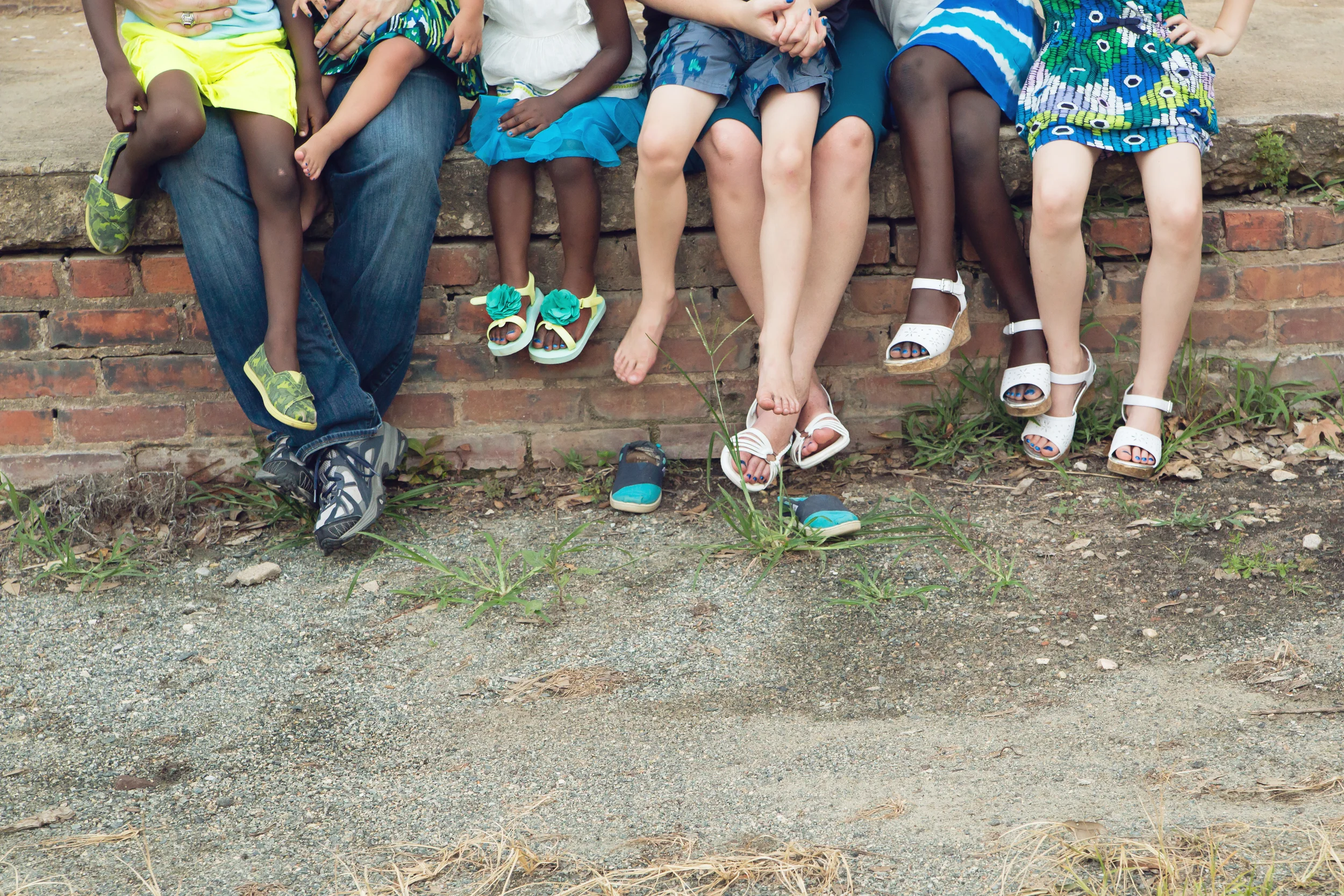
A lesson in safety from an outing with my kiddos

Yesterday we trekked to Monkey Joe's, a place o' fun filled with inflatables that bring great joy to my children. The first time we went, I was apprehensive because I know they're little - Robbie is 2 and Jocelyn is 4 - and bigger kids could knock them down. After our first few visits, though, my kids had the confidence to run the place. And I was confident about that too.

Until yesterday.

I knew it would be crowded, given that the forecast called for 101 degrees. Now I grew up in Florida and taught for a few years in south Texas, but even I will admit that 101 is hot. Monkey Joe's is an air-conditioned place where kids can run around. I knew we wouldn't be the only ones to find that appealing on such a hot day.

It was crowded. The crowds in general weren't the problem, though. Two school/camp groups were there. One was a perfect model of a group of kids who had been instructed about how to behave respectfully and who were held accountable to that by their leaders. The other group ... well, they were the opposite.

We had planned to stay for a few hours, but the second group changed our plans. My son, who used to act like he owned the place, asked to be held instead and clung to my neck. My daughter asked me last night, "Mommy, why were those big kids so mean? Do they not know about Jesus? Maybe we should have told them Jesus loves them and died on the cross for their sins."

The leaders of that group all sat at tables, only interacting with the kids if they happened to run past. The kids realized this, so they behaved within sight of their leaders and wrestled with, punched, and shoved each other as soon as they were out of sight. It wasn't pretty.

Those kids never meant harm to my kids, but they weren't paying attention either. My kids were pushed down a couple times, once stuck under a pile-up of big kids for a moment. And my kids sometimes had to wait in longer lines because some of those kids cut in front of them.

And so we left. It was not a safe or enjoyable place anymore.

This is why it's important to have safety measures in place in special needs ministry (and other ministries) at church. If your church is not a safe place, then it's not a place any family can be comfortable bringing their children. If our ministry is unsafe, it's not a place where people can even hear the gospel because they're going to be too focused on safety concerns to pay attention to anything we say about Jesus.

Next week I'll be writing about church policies for special needs ministry. Policies aren't always fun, but they are purposeful. One of those purposes is to ensure that our churches are safe places for people with and without disabilities.


(And, to give credit to the folks at Monkey Joe's, I spoke with the manager who offered us vouchers to visit another time. Next time we'll call ahead to inquire about groups scheduled for that day.)

What do YOU think? (...about recruiting volunteers from outside of your church)

I recently stumbled across this ad on a volunteer site. It's a church sharing the need for volunteers in their disability ministry. It seems as if anyone - from within or outside the church - could respond to this. Here's the ad:

Description

We desire to provide 'Buddies' for children affected by disabilities during our one hour Small Groups for Kids program. Because we believe in 'main-streaming' our special needs children, extra support is needed to assist with participation, activities and transitions. A Buddy for a child affected by disabilities can go a long way to telling their families that they are treasured at New Harvest Church.

Skills

  • Team Player: 1) Ability to work in with well-established programs for one hour each Sunday morning (either at 9 or 10:45 am), providing needed support for one child with a disabling condition; 2) Willingness to connect with the families of children affected by disabilities, providing a much-needed link between the often isolated with the rest of the Church congregation; 3) Commitment to stay in touch with the Special Needs Coach and Family Life Director as situations and needs change.

Requirements

  1. 18 years of age
  2. Love for children
  3. Willingness to commit and serve 4 Sundays a month, for one hour (with 10 flexible Sundays off) for a period of one year.
  4. Participation in training, orientation, which includes a background check.

I don't know anything about this, other than the posting itself. I don't know how they handle it if someone who isn't a Christian or isn't a church member responds. So we can't speculate on this church's practice.

(And, in case you're wondering, yes it can and does happen that people outside your church or even out Christianity might respond. We've had some inquire about serving with us at our church. So don't just assume, "Well, they wouldn't respond unless they had a tie to our church." It happens.)

So let's talk about this one. What do you think about the practice of recruiting ministry volunteers from outside of your church community? I'm thinking about this from a special needs ministry perspective, but you could approach it from any ministry angle.

Please leave a comment to get the conversation started!

When pop culture gets it wrong

A couple months ago I wrote about what the church can learn from pop culture. Today I want to point to a couple issues that remind us that we are to be set apart too, living in this world but reflecting Christ in us rather than the world around us.

If you read much in the special needs community, you've probably heard about GQ's stupidity. In the latest issue, they had a list of the worst-dressed cities. (And my husband would like you to know that he represents Raleigh well on that list. His words, not mine!) I found the page through a link from my local news about Raleigh's place on the list. And, as I scrolled through the other cities, I gasped and tears sprung to my eyes when I saw this: "but due to so much local in-breeding, Boston suffers from a kind of Style Down Syndrome, where a little extra ends up ruining everything."

Wow.

I haven't seen an apology yet for Tracy Morgan's "comedy" warning folks against messing with moms of kids with special needs and comparing those kids to chimps, and I don't know if we'll see an apology for this either. The GQ folks have changed the wording, dropping reference to Down syndrome, on their website.

Noah's dad - also known as Rick Smith - wrote about this yesterday with an open letter to GQ. As Terri Mauro said in her piece yesterday, Denying Our Children's Humanity for a Laugh,
Inbreeding? Really? But I think the key is in that last little bit: When you see people with Down syndrome as ruined, you dehumanize them in a way that makes mocking them no more emotionally involving than mocking, say, a chair. And then you also get to mock the people who get upset about your chair mockery, because, man, it's just a chair! Can't we even insult chairs now?

This, my friends, is why I argue that it's worth taking a hard line with the students in your youth group against slurs about disabilities, like throwing around the word "retarded." I've had youth leaders say, "Shannon, c'mon, there's much more important things to focus on than the word retarded." To which I respond, "so you would be comfortable with them dropping the f-bomb because there are more important things to focus on than that?" Words matter. And even more than that, people matter. This is even more about people than it is about words.

Sure there are examples of secular and religious groups who show love to individuals with special needs, and pop culture doesn't always get it wrong. But there are also countless examples of people and groups and media and even churches who insult or reject people with special needs.

Let's set ourselves apart by showing with our words and actions that "the parts of the body that seem to be weaker are indispensable" (1 Corinthians 12:22).


On a related note, though, our hearts matter more than our words or programs or inclusiveness. Check out John Knight's post yesterday at Desiring God, in which he reminds us: "We can create elaborate programs and train people to use the right words and help people behave properly toward those with disabilities — yet completely leave God out of it, ignoring or even discounting all that God has said about his own sovereignty over all things, including disability." And while you're at it, read about four things Mike Anderson has learned about God through his baby who was born blind.)

I'm not ___________ so that I can ___________.

Last week my friend Steve posted about priorities. And then today Michael Hyatt posted about the importance of saying no. And Jenny posted about how to avoid discouragement in ministry, and her first point was about getting back to the basics, which is hard to do when your priorities are askew. And fellow special needs ministry blogger Amy (from The Inclusive Church) admitted on Twitter that she struggles with that.

God is working on my heart in this area. I'm not sure that I fully agree with Steve's use of Nehemiah 6:3 to support this (because while Nehemiah is saying that he can't come down because he's doing a great work, the issue at hand wasn't the great work but the avoidance of an individual scheming against him), but we do see this principle elsewhere. Christ rests. He waits before running to a need in some instances (like when Lazarus was dying and he waited two days). We see that Christ took time to get away and pray in several verses.

You know the feeding of the 5000? And the story of Christ walking on water to the boat, when the disciples thought he was a ghost? We teach both of those stories, but we often skip what happened in between: "And after he had dismissed the crowds, he went up on the mountain by himself to pray..." (Matthew 14:23). That's why he wasn't on the boat and why he had to walk on water to get to it later. Jesus didn't get on the boat when everyone else did so that he could pray.

How can you fill in those blanks today? I'm not ___________ so that I can __________. 

We have to say no to some things to say yes to the right things.

And this is true in special needs ministry too. Right now at our church we're saying no to certain things so that we can say yes to others. We can't do everything. We do desire to grow to a place in which we can say yes to more things but we have to be wise and honest about what we can and can't do right now. Our church isn't _______________ so that we can ____________. 

For every person and every church, those blanks will be different. What are your answers to those blanks?