the funny thing about plans

I wasn't planning to post today, but I fell asleep while my husband was bathing our little ones and now, in the wee hours of the morning, I am awake. At 9:00am I will arrive at the hospital to visit with an old youth group student who just gave birth this week, and then I'll check in at 9:30am for surgery, which will be at 11:30. If all goes as planned, we're looking at one hour of surgery and two hours in recovery, putting me home by about 3:00 or 3:30.

If all goes as planned...

As I wrote those words, I realize that they're odd in the context of the past few years of my life. Precious little has gone according to our plans, if I'm honest with you. We had planned to wait until we had been married five years before we had children; we were expecting Jocelyn before our first wedding anniversary. We had planned to spend our 20s traversing rock faces as we climbed and even slept against the mountain; the bone damage that occurred in the year before I was diagnosed with rheumatoid arthritis squashed those plans. (I kid you not that the picture below shows our plans for sleeping during multi-day climbs ... note that is NOT us, just a photo I found online to show you what I mean.)


We planned to stay in our current house forever; now we're preparing to list it for sale next month and move to a wheelchair-accessible home closer to our church so we can have all of the families from Access over to our house and host Bible studies for our kids in our home. We planned to have two kids biologically and then two or three via adoption from foster care; I spent yesterday afternoon looking at faces on the Reece's Rainbow site of little girls with Down syndrome in Russia who don't have families, one of whom we hope will join our family in two or three years. And while we still plan to adopt from foster care after that, we know enough now to know that our plans will always be flexible.

I like plans, so that last statement would make me a little twitchy if I didn't know that God's plans will always prevail and are always best. If our plans had won out, neither of these two would be part of our lives.


Oh, yes. The mohawk and the pigtails. Don't those pictures just make you want to melt, or am I just biased? (Don't answer if it's the latter!)

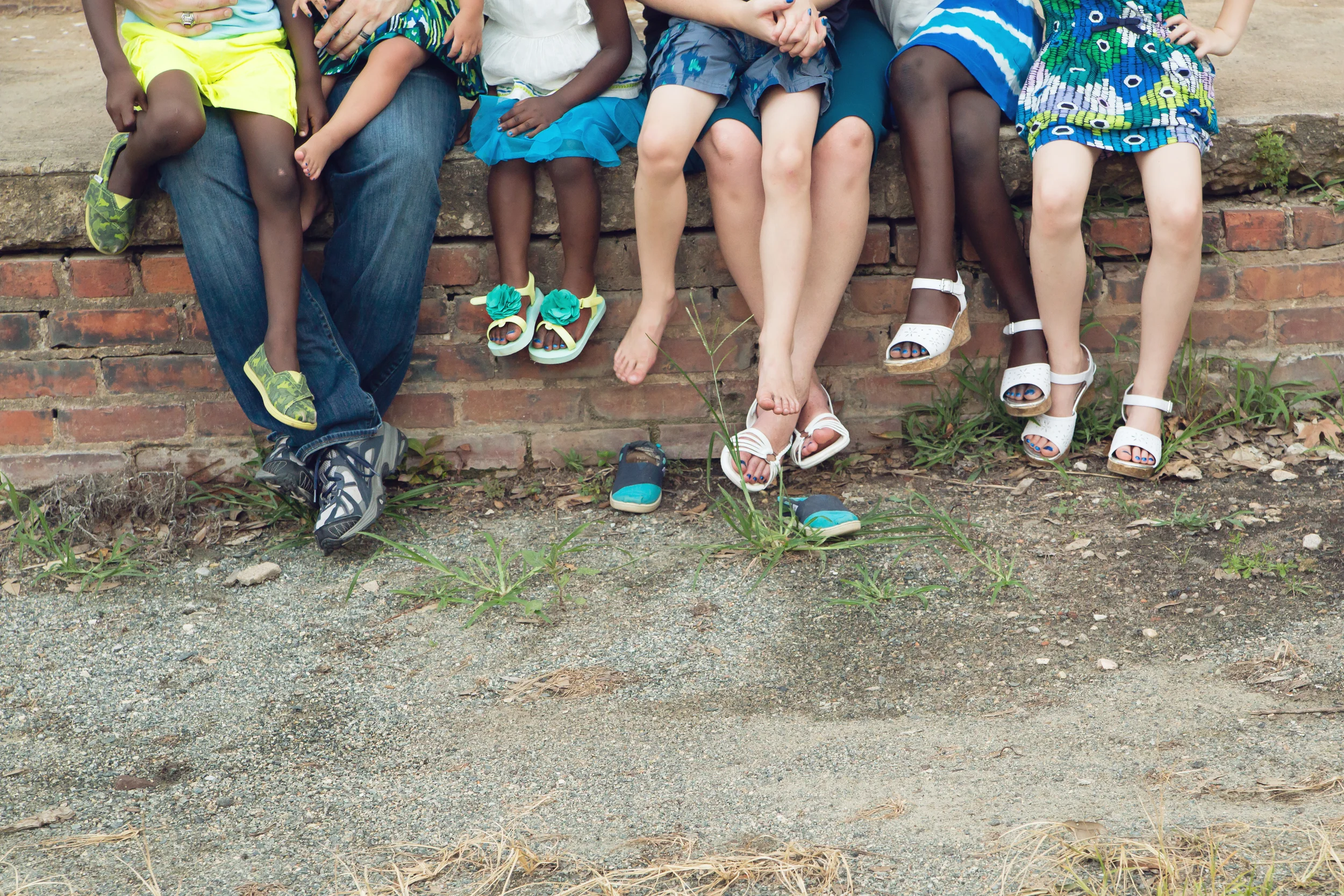
If life had gone as we had planned it, our family picture wouldn't look like this...


A life by my plans wouldn't have included RA or the surgery I need today because of RA. It wouldn't have included the couple of other chronic autoimmune disorders I have, the other two surgeries I've needed since our wedding day, or the medical bills we now budget for.

And my plans wouldn't have included not being able to eat after midnight. (Yes, I am hungry and thirsty right now, thanks for asking. I can't have anything from now until after surgery. I know I'll probably be queasy on pain meds after I wake up, but I'm still thinking about keeping a list for Lee of the foods and drinks I want post-surgery: an orange slurpee from Sheetz, Goodberry's mint chocolate chip frozen custard, Bo Berry biscuits from Bojangles, a mix of vanilla and cookies n cream and a dash of tropical sorbet frozen yogurt from YoMo with Nerds candy on top, a skinny vanilla latte with a pump of chai flavor from Starbucks... what's that you say? Why, yes, I do have a sweet tooth. Why do you ask?)

God's plans are better than mine. Always. That would be true even if I didn't have a husband who serves me beyond what I deserve and if I didn't have mohawk boy and pigtail girl. When I can see how God's plans will work for my welfare, they do.

And when I can't, they still will.

For I know the plans I have for you, declares the Lord
plans for welfare and not for evil, to give you a future and a hope.
Jeremiah 29:11

Disability ministry weekly round-up {10/20/11}

I know this weekly feature usually goes up on Mondays, but I had another post pressing on my heart for that day. While I intended to just delay the round-up by a day, I've been in a lot of pain this week due to my knee. Praise God, though, that my surgery was moved up to this Friday - that is, tomorrow! - which also means I've been busy making sure everything is in order for me to be out this Sunday. On that note, let me plug the beauty of high school student volunteers who are willing to be trained and then to sub when we need them (especially because three of our weekly one-on-one buddies are out of town this week)!

 What is God sovereign over? Justin Taylor does a great job of providing verses in various categories. (Thanks, John Knight, for highlighting this.)

Special Needs and Family Ministry: I forgot to link to this one a couple weeks ago, but it is an excellent and thoughtful guest post on The Inclusive Church in which Meaghan Wall is honest about an area she has overlooked as Special Needs Ministry Coordinator at her church as well as forward-thinking about what she is doing and will do differently. Family discipleship is not just for families without disabilities.

Churches try to be accessible to people with disabilities: This is a new article written about a recent disability ministry conference.

Ever wonder why most churches start disability ministry in children's ministry as a first step, only later moving to adults as well? Perhaps this paragraph from an article about families with autism and the hope for cure sheds some light on kids vs. adults:
Sometimes children can be more tolerant than adults, said Mandy Greer of Lexington Park, whose son, James, falls in the middle of the autism spectrum. Adults can find him disconcerting — the family has stopped attending church because James can’t be still and quiet during the service — but children accept his differences, including his near-inability to speak, more or less with equanimity, Greer said.

Piece by Piece: Are Houses of Worship Welcoming? This is a great article all around, but I found this section particularly convicting:
The Broadway community is creating special performances that will take sound and light into consideration for those on the autistic spectrum. Their first special performance of "Lion King" was such a hit that they are already planning the next show.
Movie theaters have been doing similar types of special performances for a while. If other groups can understand our autistic spectrum community's needs, it is time our religious communities begin to think about them as well.

{equal}: Katie's post about her visit to Dallas to discuss disability and theology with Chuck Swindoll, his daughter Colleen, and his grandson Jonathan will make you reconsider the word "equal."

For a bit of humor to your day...Ed Stetzer's eight-year-old daughter wrote the plans for a dog race, and I thought it was cute that she even considered dogs who might have a disability of some sort. I was chuckling long before I got to that line, though. Consider it the medicine of a cheerful heart, à la Proverbs 17:22!

Churches welcoming people with disabilities in the news this week:
  • a church that not only supported a 14-year-old member with Asperger's as he planned an autism awareness walk but also cancelled church that day so members would be free to join him,
  • and, while I don't have any others to include here, several churches did either update or launch a disability ministry page on their websites this week, so progress is being made!
I do still plan to make those posts about respite care at other churches, but I'm having to be patient with myself in acknowledging and accepting what I can and can't do right now with the degree of pain I'm in. Thanks to you, too, for showing me that same patience as well! 

    why I care about disability ministry

    This week's weekly round-up of links related disability ministry, which usually posts on Mondays, will run tomorrow instead. This post was begging to be written and posted first.

    I began engaging in special needs ministry because I realized that the church was not rushing to or showing love to people with disabilities and their families. Not only are many churches ignoring the needs of this community, some churches are often outright rejecting individuals with special needs. Every new family with a disability arriving at our church has shared the story of at least one church that turned them away; one parent at our respite care event a couple weeks ago told me, "Our last church told us we weren't welcome there anymore." When my friend Mike, his wife, and his triplet sons - each with autism spectrum disorders - moved to St. Louis in 2002, he called 37 churches; all 37, upon hearing about his children's needs, told him that his family wouldn't be able to come to their church.

    Praise God that Mike's family did find a church in St. Louis and that many churches are indeed stepping up to embrace these children, teens, and adults and their families. For those that aren't yet there, here are the facts that require a response from us as the body of Christ:
    • When parents learn of their unborn babies' diagnosis of Down syndrome prenatally, 92% choose to abort rather than welcome a son or daughter with Down syndrome into their families.[i]
    • When a couple has a child with autism or ADHD some research indicates the the rate of divorce is nearly twice as high as for parents whose children don’t have disabilities.[ii]
    • While the risk of divorce decreases after children turn eight for most couples, marriages with a child with autism have a continued higher rate of divorce in adolescence and early adulthood.[iii]
    • Some disability ministry leaders have estimated that 80-95% of people with disabilities are unchurched.[iv] While I can’t find any documented research to back that up, my experience in the disability community as an educator and researcher confirms that adults with disabilities are less likely to attend church than other adults (supported also by this study), as are families that include a child with a disability.
    • People with disabilities are less likely to attend religious services than nondisabled Americans.[v]
    • Recent research from Boston University indicates that people with autism are more likely to be atheists and more likely to reject organized religion in general.[vi] The parameters of that study didn’t explore why this trend exists, but it could be related to the church’s failure to show hospitality to and share the gospel with them.
    • As organizations like The Barna Group have studied other aspects of the intersection between the church and unreached people groups, little to no research is available about the welcome – or lack thereof – for people with disabilities within the body of Christ.
    • Furthermore, while it would be unacceptable to close the doors to the church to any group of people, this is no small group: About 54 million people in America (19% of the population) live with some level of disability, according to the U.S. Census Bureau in 2008, a group approximately the same size as the combined populations of Florida and California; 35 million Americans (12% of the population) have a severe disability.[vii] Nearly one in six children has a developmental disability.[viii]
    If we love the gospel, then we can’t deny that it is not just for those who behave, walk, talk, and think like we do. The beauty of the gospel is that it is not dependent upon my ability or yours but rather on the love and faithfulness of Christ, who lived the sinless life we couldn’t live, died the sinner’s death we deserve, and rose from the dead to conquer sin and death that we may live with him forever. Just as the disciples in John 9:2 didn’t understand that disabilities aren’t caused by the sin of the person who is disabled or their parents, the church today also needs to hear Christ’s answer in John 9:3 that disability doesn’t disqualify people from membership but instead is one way that the works of God are displayed in this world.

    God made me passionate about this before my body developed a mild degree of physical disability due to rheumatoid arthritis, but I am thankful that my present circumstances help me focus on the eternal glory of our God rather than the fleeting comforts of this world. I'm not paid by my church or anyone else to coordinate special needs ministry for pre-birth through high school and collaborate with the woman who coordinates the adult side of what we do. I’m just a stay-at-home mom to two preschoolers who cherishes the opportunity to spend herself on behalf of God for his people, to loosely paraphrase Isaiah 58:10.

    Won't you join me?


    [i] Mansfield, C., Hopfer, S., & Marteau, T. (1999). Termination rates after prenatal diagnosis of Down syndrome, spina bifida, anencephaly, and Turner and Klinefelter syndromes: A systematic literature review. Prenatal Diagnosis. 19; 808-812.
    [ii] Wymbs, B. T., Pelham, W. E., Molina, B. S. G., Gnagy, E. M., Wilson, T, & Greenhouse, J. B. (2008). Rate and predictors of divorce among parents of youth with ADHD. Journal of Consulting and Clinical Psychology. 76(5); 735–744.
    Hartley, S.L., Barker, E.T., Seltzer, M.M., Floyd, F., Greenberg, J., Orsmond, G., & Bolt, D. (2010). The relative risk and timing of divorce in families of children with an autism spectrum disorder. Journal of Family Psychology. 24(4); 449-57.
    [iii] Hartley, S.L., Barker, E.T., Seltzer, M.M., Floyd, F., Greenberg, J., Orsmond, G., & Bolt, D. (2010). The relative risk and timing of divorce in families of children with an autism spectrum disorder. Journal of Family Psychology. 24(4); 449-57.
    [iv] McNair, Jeff: http://jeffmcnair.com/Ukrainenewspaperarticle.doc
    The Christian Institute on Disability, quoted by Hsu, Al. (2008). Surprised by disability. Christianity Today. 52(10). Accessed at http://www.christianitytoday.com/ct/2008/october/15.100.html
    [v] The National Organization on Disability. Religious Participation: Facts and Statistics. http://www.nod.org/religion/index.cfm
    [vi] Caldwell-Harris, C., Murphy, C.F., Velasquez, T., & McNamara, P. (Unpublished). Religious Belief Systems of Persons with High Functioning Autism. Research paper from the Departments of Psychology and Neurology at Boston University. Available at http://csjarchive.cogsci.rpi.edu/proceedings/2011/papers/0782/paper0782.pdf
    [viii] Boyle, C.A., Boulet, S. Schieve, L.A., Cohen, R.A., Blumberg, S.J., YEargin-Allsopp, M., Visser, S., & Kogan, M.D. (2011) Trends in the Prevalence of Developmental Disabilities in US Children, 1997–2008. Pediatrics. Accessed at http://pediatrics.aappublications.org/content/early/2011/05/19/peds.2010-2989.abstract?sid=ab290d14-2d60-411d-bf0c-00bb150716aa


    Announcing...the Inclusion Fusion websummit! (and it's free!)

    Alternate title: Why I've been MIA lately

    I love ministry conferences. I love the opportunity to connect with others who are passionate about serving God and his church in humility and truth, and I love the chance to learn from others. I don't love, though, having to figure out the logistics and travel and accommodations and cost and babysitters required for me to attend a conference.

    That's why I'm so excited to share with you the upcoming Inclusion Fusion websummit, organized by Key Ministry and PajamaConference.com. I have had the privilege and honor of serving on the program team, so I can tell you first-hand what a unique and edifying event this will be.

    And what makes it so exciting, apart from the speakers who I'll share below? Well,
    • it's free,
    • it's online so you can participate from any location with an internet connection,
    • each session will be available 24/7 during the three days of Inclusion Fusion (which are November 3, 4, and 5), so you can plan your watching time around your schedule (or, if you want to join together with your entire team to watch a session, you can plan around the schedule of your group),
    • it includes sessions designed specifically for parents and others specifically for ministry leaders (though many will apply to both groups),
    • and did I mention that it's free?
    For more on the logistics of the conference, see my friend Steve's post here or register (for free!) here.

    Our keynote address is from Chuck Swindoll, who has been a great friend and advocate of disability ministry for years and whose church has a thriving special needs ministry. The latest line-up of other speakers, as of October 8th is below...and I think you might know the second person listed (me!):
    • Jeremy Collins: Using Social Media in Special Needs Ministry
    • Shannon Dingle: Common Misperceptions About Disability Ministry and Disability, the Sanctity of Life and the Church
    • Barb Dittrich: Bathing in the Healing of Forgiveness
    • Amy Dolan: Customizing Your Curriculum
    • Ryan Edlind: Church and Mental Health…Bridging the Gap From a Leadership Perspective
    • Joe and Cindi Ferrini: The Unexpected Journey of Relationships-When Special Needs Change Our Course!
    • David Glover: The P.U.R.E. Ministry Project: What, When, Why and Where?
    • Steve Grcevich: Kids With “Issues”…The Mission Field Next Door
    • Rebecca Hamilton (with Katie Wetherbee): Got the Keys? Starting Your Ministry 
    • Harmony Hensley: Inclusive Ministry Environments
    • Jim Hukill: Renovate: Transforming a Disability Movement
    • Connie Hutchinson: The Road to Independence
    • Marie Kuch: To Be Announced
    • Rhonda Martin: Nurturing Spiritual Growth in Kids With Anxiety
    • Jeff McNair: Integration as a Core Value
    • Amanda Mooney: We know we should…but HOW?
    • Libby Peterson: Relational Respite-A “Go To Them” Theme
    • Jolene Philo: Ten Ways Churches Can Support Parents of Kids With Special Needs
    • Colleen Swindoll-Thompson: To Be Announced
    • Bob West: Where is My Heart?
    • Katie Wetherbee: How To Advocate For Your Child At Church
    • Laura Lee Wright: For Kingdom’s Sake
    I do want to give you the heads up that this group includes a variety of different Christian denominations and traditions (including Southern Baptist, Roman Catholic, and Presbyterian, to name a few) and a variety of roles (with one or more of each of the following: church staff members, pastors, volunteers, parents, ministry consultants, non-profit leaders, authors, and child psychologists). I think you'll enjoy the benefit of such an approach, but it also means that you might not agree on all matters with each speaker. I know I won't, but I'm okay with that. Also, you can watch as many or as few sessions as you want, so you're not locked in to all the sessions if you're not interested in or in agreement with one or more of the sessions.

    Finally, I would love your prayers for my two sessions, Disability, the Sanctity of Life, and the Church and Common Misconceptions about Special Needs Ministry. I am putting the final touches on them, while planning for knee surgery, scheduling a follow-up liver ultrasound to check on an issue I had six months ago, battling some insomnia issues, starting plans for our December 10 respite and our spring Joy Prom, and being a stay-at-home momma to my four-year-old artist and two-year-old climber (love my job caring for them!). Suffice it to say, I am tired, but God is good.

    Even once the recordings for the sessions are fully edited and submitted, I would love for you to keep praying for the event and for the individuals who will join us for it (and hopefully you'll be among those!).

    Special needs ministry weekly round-up! {10-10-11}

    Last week I shared about our church's recent respite care event, and this week and next I'll have a few posts about our churches' respite events that  our Access intern (who ROCKS!) researched this past summer. Kelsey has thanked me for letting her serve with us, but we are truly the ones who are blessed!

    If you read no other link in my post today, let it be this one about the majesty and wonder of God's marvelous works in a Joni & Friends mission trip in which a young man with cerebral palsy and in a wheelchair served alongside his parents: Wheelchair clinic allows disabled son to serve, too

    Great tips from Jenny Funderburke for ministering to kids who are hyperactive!

    Has Down syndrome hurt us? This sweet post from a mother vulnerably shares her fears upon diagnosis and lessons she learned afterward, leading to these answers: no, Down syndrome hasn't hurt us, and yes, it is a life worth living.

    Two boys are a Catholic high school: one black, one white; one with cerebral palsy and Asperger's syndrome, one without any disabilities. And God brought them together with compassion in this story.

    And while I am willing to bring attention to our failures as a church to welcome people with disabilities, I love highlighting the successes too, like these:

    That's all for this week. I hope you're having a great Monday!