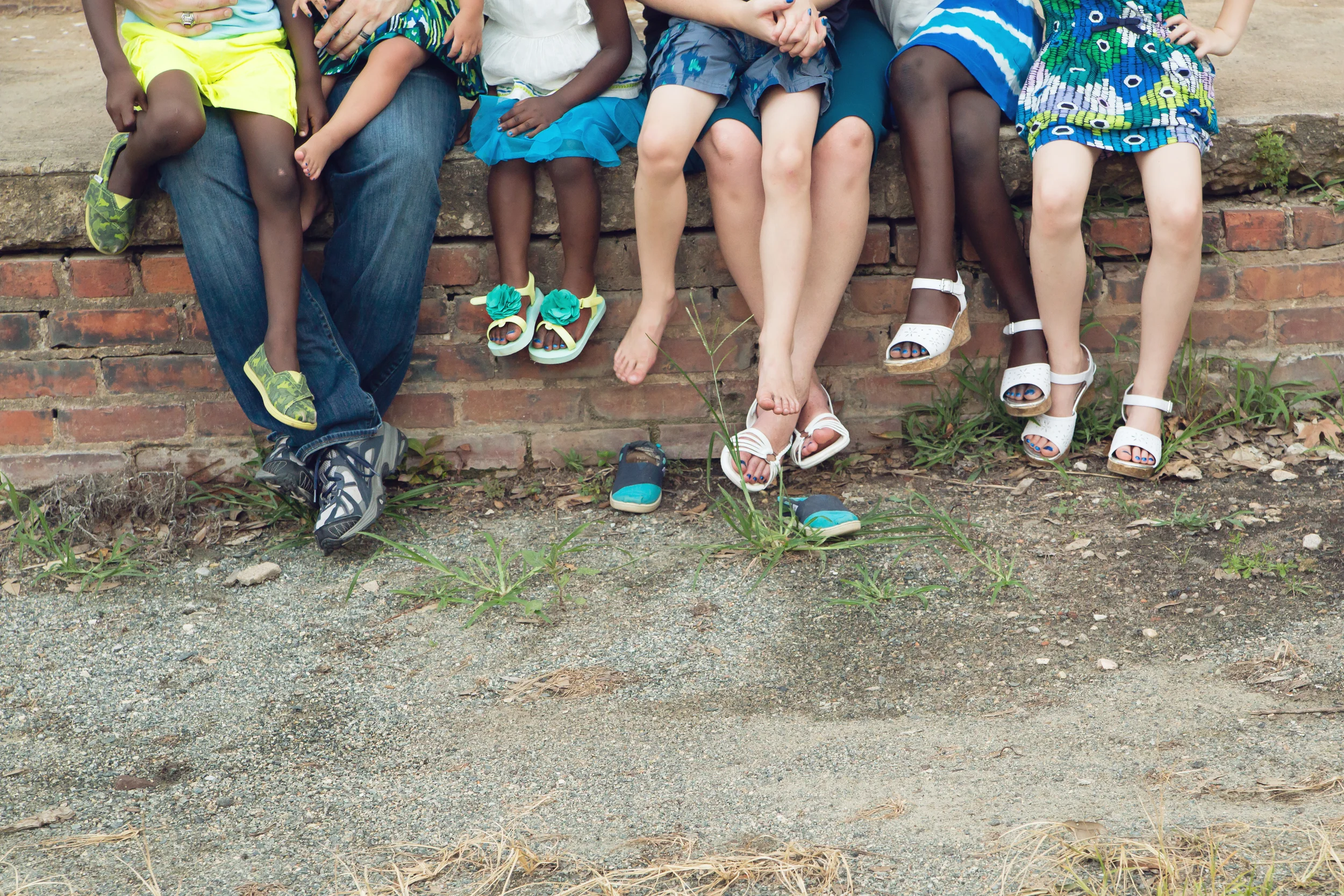
Sometimes, you have to pack up and go home. (On leaving #D62012 early)


I drafted this post while on a plane earlier today. I've gotten interrupted five times while trying to post it - once to find a small blankie that my five-year-old daughter always sleeps with, once to remind our three-year-old son that it's bedtime, and three times to calm our sweet Taiwanese-American girl when she cried out for "mama," checking to make sure I was still here. (Oh, adoption, I love you, but my heart hurts that our youngest hasn't always had a mama she can trust to be there.) 

Want to know something about those interruptions? I cherished every. single. one. Now, on to the post to explain why...

I hoped to connect with others passionate about family ministry this week while I spoke at the pre-conference and then hung out for the main conference of D6. I did the pre-conference part yesterday, and it was fantastic. 

Truly, D6 is an amazing conference in which people serving in all areas of the church – with children, youth, adults, people with disabilities, married folks, singles, two-parent households, single-parent households, married parents, unmarried parents, and the list goes on – join together in the conversation about what we can do to equip families to live out Deuteronomy 6, including these verse from that chapter:

“Hear, O Israel: The Lord our God, the Lord is one. 
You shall love the Lord your God with all your heart 
and with all your soul and with all your might.
 And these words that I command you today shall be on your heart. 
You shall teach them diligently to your children, 
and shall talk of them when you sit in your house, 
and when you walk by the way, 
and when you lie down,
 and when you rise. 
You shall bind them as a sign on your hand, 
and they shall be as frontlets between your eyes. 
You shall write them on the doorposts of your house and on your gates.

I hope to return to D6 again in the future. No other conference, in my opinion, is as rich and deep and biblically focused as it is.

But, as I write this, the main conference is going on, and I’m on a plane home.

Why?

Because my husband has a nasty cold. My oldest child had a fever yesterday. My youngest isn’t too keen on the mom she’s only known for two months going MIA. Thankfully, my son is doing well with it all, but he’s feeling the effects of everyone else and – quite frankly – I was homesick for all of them before I found out how life was going at home.

And while I can have that conversation about how to best equip families with special needs another time and while others can have that conversation without me, no one else can be wife to Lee and mom to Jocelyn, Robbie, and Zoe. My husband could have made it all work back home without me, and he didn't ask me to leave. I just knew I needed to when I considered that my choices were to stay and talk about how to best minister to families or to go home and minister to the family that is mine and that needs me.

While I wish I could finish the trip I had planned, I’m thankful that God has made it clear where I need to be and where the place of my first ministry is.

I don’t have to go home. I get to. 

~+~
I'd also like to add that I'm grateful for the D6 team who hospitably welcomed me and supported me through the sessions I led and who graciously helped me rearrange my plans to return home early. They don't just talk the talk; they walk the walk. 
#D62012 special needs ministry: "Ministering to Families Impacted By Disability - More Than Adding a Ramp to Your Church (Marie Kuck)

This is a continuation of posts today as I blog about the special needs track at the D6 conference. This post tells you all of the sessions on the track, and here's my blogging of Marie's first track. I'll be posting about my sessions later this week. (Sorry, can't speak and live blog at the same time!) This is my live blogging of Marie's second session.

We think of people with disabilities as the wheelchair and immediately jump to physical accessibility. This is important! But more important are the attitudinal barriers that people can't get past in their mind.

Some good nuggets from Marie's talk:
  • "My little boy was no less a creation of God and a valuable soldier in the kingdom than anyone else. We need to move from being tolerant to being intentional, with arms wide open to receive you, even if I don't know what it will look like. Let's go on this journey together."
  • "We aren'y doing this for 'those poor people who have special needs.' It's not a department in your church. They're part of the community. This is the body of Christ."
Often not until we acquire a disability or have a child with a disability that we realize what we've been ignorant about.

She shared "Welcome to Holland." (If you're not familiar with it, Google is your friend. You should be able to find it. It's an analogous story of what life is like for families who have a child with disabilities.) It can be hard for parents when their kids don't hit milestones at the same time as other kids. We need to celebrate the milestones that they do meet, whenever that happens!

GREAT TIP FOR CHURCHES (note from Shannon: that I've seen at other churches too and that we're looking into for ours when we redo our parking lot): In addition to handicapped parking, have designated spaces for families with disabilities who might not qualify for a handicapped placard. Have members of your church hospitality team ready to help when they see a family pull up, assisting them with getting kids out of the car and to their classes or to the worship center.

In this session, Marie shared a lot of details about their lives before Nathaniel's "change of address" to heaven. Here's the link to that story at Nathaniel's Hope. She shared another story of a mom who used to come to respite, drop the kids off, and go recline her driver's seat and sleep for three hours because she was a single mom and had no family support - this was the only break she got. (Note from Shannon: I also love a story from Key Ministry's Harmony Hensley's presentation about respite when she shared about a mom who, after respite, told them, "I went to Target. I've never been there before. I was just as beautiful as I had heard." She walked up and down the aisles, crying, so thankful to be out and shopping.)

At the end, a dad with a child with special needs shared how much it means to his family and his daughter when people come to things like her Special Olympics bowling times. He suggested, "Just be there and be incarnational in that way." He also suggested that a great question to find out how to minister to families affected by disability is simply, "Tell me about your family," instead of tell me about your child's disability.

I'll be blogging about my sessions later this week!

D6 Special Needs: Disability is Not My Thing... Help Me Find, Equip, and Sustain My Team! (Marie Kuck)

Marie leads Nathaniel's Hope, named for their son who had multiple disabilities and who, in Marie's words, "had a change of address" eleven years ago when he went to heaven. She began by sharing her story, in which her church loved their families but didn't know what to do with them (and in which she, for example, spent many Sunday mornings in the car with Nathaniel while the rest of the family worships because his feeding tube had leaked and made a mess on them.)

This is my favorite part so far: She just asked how many of us have kids with special needs. I was the only one who raised by hand. The rest of the room is folks who care about special needs ministry without being a special needs parent. (This is a BIG change from what I often see in sessions like this, where usually at least 10-20% - in not many more! - in the room has a child with special needs.)

The Fear Factor: Many of us are afraid to interact with those who are different from us. We need to start thinking by what people CAN do (their abilities) and not what they CAN'T do (their disabilities). It often fails to just put out a bulletin notice for volunteers because people are intimidated unless they clearly know the role they'll be filling.

IDEA: You can go serve at the Down syndrome or autism walk in your community or the Ronald McDonald House to help members of your church become more comfortable serving with people with disabilities.

Matthew 25:40 - "As you have done it until the least of these, you have done it unto me."

Volunteers DO NOT need a special needs background. They just need a willingness to learn and serve with compassion. Sometimes, volunteers can help you understand what they can do and want to do (for example, a senior citizen who is not able to chase after a child but would love to sit and read with one or make phone calls to check in with parents).

Our lives and churches are made richer places by people with special needs. "My son who never learned to walk or talk or eat by his mouth blessed my life in ways that our other children never could have."

It's okay to seek outside professionals (including college students who are professionals in training), but you want to be finding people within your church to serve as well.

Respite care is a GREAT way to train volunteers by giving them a chance to serve in a short-term, low-pressure, relaxed environment before they commit to regularly help on Sundays or mid-week ministries. You can use respite care as a way of recruiting longer term volunteers.

ALL teachers need to understand about special needs ministry, not just the volunteers who are serving directly with a child with special needs. Find people to help give respite to your volunteers at times to back them up or to come in and offer extra training, so that volunteers don't burn out and stay with your team for a long time. (Note from Shannon: If you invest in volunteers well, you won't have to recruit as much because you don't be losing volunteers who you need to replace as often.)

Intake forms help volunteers because the info on the forms can help them understand the needs of the child they're paired with. (Note from Shannon: I'll be posting our intake form here last this week if you need an example.)

Marie shared a lot of resources that can be found on their website here: Nathaniel's Hope's Resource Page

Questions people asked:
(I'll be posting about each of these with answers from me and Marie next week.)
  • Our church had a special needs ministry but then we had some splits and now we're working from the ground up to reestablish something. What's the first step?
  • Our church's biggest need is organizing respite care well. We have it quarterly with about 20-25 kids. How do we organize the team to go from that to stay on mission on Sunday morning?
  • We just had fall kick-off, and now I have Sunday school teachers come to me and saying, "I think we have a special needs situation here." Now I feel like we have the cart before the horse. Is it okay for me to approach a parent to ask if there's some special need situation present so that we can serve the family and the child well?

D6 special needs track live blogging

Hi, friends! Today I'm here at the D6 pre-conference labs, sitting in on and presenting in the special needs ministry track. I can't live blog my own sessions (I'm not that good that multi-tasking!), but I'll be blogging through Marie's sessions today and I'll post about my content last this week.

Here are the sessions on the schedule today:
  • Disability Is Not My Thing... Help Me Find, Equip, and Sustain My Team! (Marie Kuck)
  • The Nuts & Bolts of Special Needs Ministry (Shannon Dingle)
  • Ministering to Families Impacted By Disability - More Than Adding a Ramp to Your Church (Marie Kuck)
  • Respite Care: Planning a Successful Outreach to Families with Special Needs (Shannon Dingle)
Thankfully, a few more sessions will have a special needs focus as well, but I won't be able to blog through those since they're opposite my sessions or Marie's. I'll try to post info here as I can get it from other presenters.

Tomorrow and Friday, the main stage sessions will be live streamed online, but the pre-conference sessions aren't. Glad to be able to share the content here!

links I'm loving in special needs ministry {9/24/12}

Every Life Matters
Three of the ladies I worked with, Amanda, Kym, and Karen, had recently traveled to Ukraine with willing hearts to do all they could to help children with special needs there. Amanda had seen firsthand the conditions the children with special needs lived in while spending time there adopting her two boys. She came home willing to do what she could to help the others left behind. Kym and Karen, both physical therapists with huge hearts for children and special needs, said, “Let’s go help them.”
Dear Santa, All I Want for Christmas is a User's Manual for my Kid
You see, Santa, here’s my dilemma. My daughter, Helene, is autistic. She knows who you are — sort of... I am torn. Do I let her go on believing you are nothing but a cartoon character? Or, do I encourage her to behave her best and send a hopeful letter to the North Pole, wishing for a magical delivery? Because, Santa, my daughter (like many other children on the autism spectrum) has a very small circle of trust, and I am lucky enough to be in the circle.
Bad explanations of the Bible kill the soul. The truth gives light and hope!
God may be pleased to use you to help me see Jesus and to give me a heart that longs to be with this Jesus who has authority over everything – like a boy with multiple disabilities who he doesn’t heal, and a wife with the constant specter of cancer over her, and all the sinful failings of my heart that is prone to wander. 
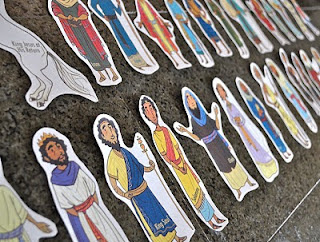
Bible People (printable)
Go to the link above to print your own! Great for Sunday school or parent-led family devotions. (Thanks, Amy Fenton Lee for pointing out this great resource.)

A special needs parent's response to "I don't know how you do it"
On good days, I get up in the morning and cut my losses and struggles from yesterday (because when you parent a child with special needs, there are usually daily losses and struggles). I look my kids in the eye, breathe out a prayer, hug them, and hold on a while because they are worth it, and our life is blessed.
On hard days, I lock myself in the bathroom for five minutes, and cry over the fact that my my daughter Evangelline doesn’t talk, or that Polly hasn’t made any real friends yet, and I look my kids in the eye, I breathe out a prayer, hug them and hold on, because they are worth it, and our life is blessed.
God Heard, God Remained
The story of Hagar and her son reminds me that God does hear the cries of one suffering boy and his mother.
Template for Movable Visual Schedule
Click the link above to go to The Inclusive Church to learn more and download the template!

4 Ways to Build Relationships with Parents

All of these are true for parents of kiddos with special needs too!

What You Can Learn from Disney about Ministering to Kids with Autism
CNN recently reported that 1 in 88 children in the U.S. have some form of autism. This means there are many children in your community who have autism. Are you being intentional about providing a place where they feel comfortable and have their needs met?