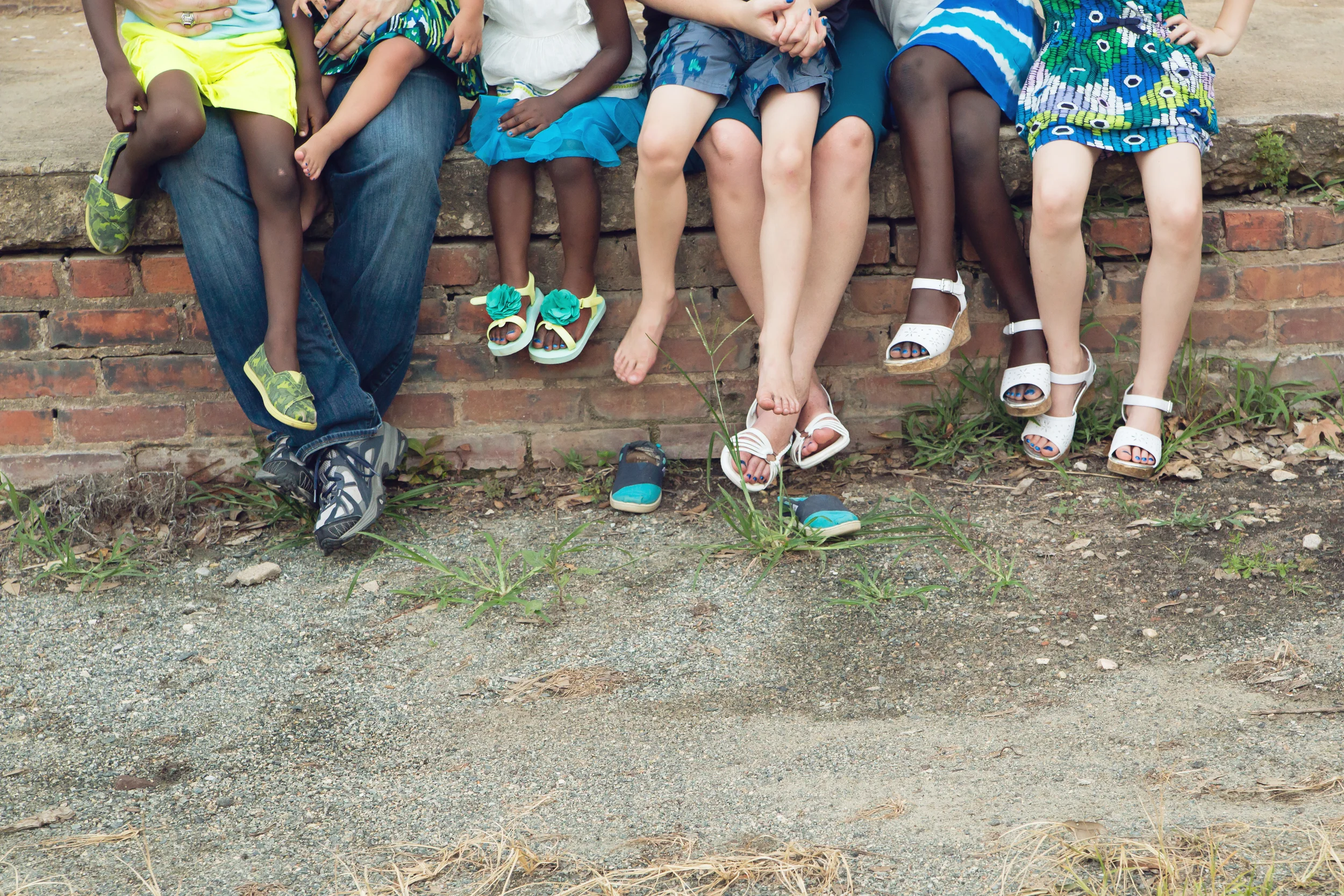
why fundraise when you can get the federal adoption tax credit?

Simply put, because our family doesn't get much of that credit back.

Side note: I know this is not going to sit well with many of my fellow adoptive parents, but if I'm honest, I don't think a federal adoption tax credit should apply to international adoption. It makes sense for domestic adoptions to be subsidized, because the taxpayers' cost of not having those kiddos in families is higher than the cost of subsidizing their adoption with tax dollars. For international adoptions? I don't see how it's in the best interest of the US government to subsidize the adoption of orphans from other countries. 

Obviously, I'm pro-adoption. Obviously, I think it's a good thing. Obviously, as we are in the process of adding three children from Uganda to our family after having added one from Taiwan, we're a-okay with international adoption. But we, as a family, made a choice to do that, and I don't think the macroeconomics make sense for taxpayer dollars to support that. 

That said, the credit exists, and just as I cashed the stimulus check while not considering it to be a wise economic move by the feds, we will accept the credit.

Let me back up a few steps. I'm sure some of you are wondering, "What the heck is the federal adoption credit?"

In the words of the IRS: 
Tax benefits for adoption include both a tax credit for qualified adoption expenses paid to adopt an eligible child and an exclusion for employer-provided adoption assistance. For tax years 1997 through 2009, the credit was nonrefundable. For 2010 and 2011, the credit was refundable. For tax year 2012, the credit has reverted to being nonrefundable, with a maximum amount (dollar limitation) of $12,650 per child.
This begins phasing out if a family's income exceeds $189,710 and phases out completely at $229,710... which, you know from my earlier post about not having to be rich to adopt, puts us safely within the qualifying range.

Side note: the amount of money in question here is why the IRS is prone to audit tax returns from adoptive families. I'm cool with that. We weren't audited, but we were ready and expecting to be. It's a hefty credit, so I expect more accountability and scrutiny when claiming it.

What does non-refundable mean? Well, it means we're only refunded what we paid in taxes. In other words, if we paid $10,000 in taxes in 2012, then we could only be refunded $10,000 instead of the entire $12,650 credit for Zoe's adoption. The credit can be spread over five years, though, so the remaining $2,650 could be applied to taxes in 2013.

Sweet! So since Zoe's adoption cost was $25,000, you'll get half of that back?

Wait, if it's $12,650 per child, doesn't that mean you'll be eligible for $37,950 in tax credits for this sibling group of three? With a total adoption cost of $40,000, you should be set with the credit, right?

No.

We make $62,000. Last year, through tithes to our church and other charitable contributions, we gave around $9,000. Combined with the refunds we get for having three kiddos and other mumbo jumbo I don't have to know about, we were only eligible to receive somewhere around $1,200 of the adoption tax credit for Zoe.

Side note: Accountants rock. having a husband who owns part of his engineering firm, which means the company pays for our taxes to be filed, rocks too. I used to do our taxes. I love not doing them now.

Being eligible for more money in tax credits won't make that refund any bigger. Actually, given the credits we'll get for having more kids, it will probably be smaller. Over six years - the five years of Zoe's credit and the five years of our Ugandan kiddos' credit, which start in the second year of Zoe's credit - we'll probably get around $6,500 refunded to us of the $50,600 would would have received if we had more tax liability.

In other words, at first the tax credit makes it seem like it would cover our adoption expenses, but it doesn't. (But WOOHOO! for $6,500. That ain't nothing, even though it won't be enough or arrive soon enough to help much with the cost of this adoption.)

That's why we are fundraising.

Nope, this picture doesn't have anything to do with the post. And it's from March. But we've had a nasty cold 'round here, so it's been low-key. Plus, it looks like Zoe is threatening to punch someone, so there's that.

Many Parts, One Body: 1. Sharing Christ, yet differing in gifts.


This is part of a series of follow-up posts from my session at the Bifrost Arts Cry of the Poor conference in April. 
  • Yesterday: Introduction
  • Today: Sharing Christ, yet differing in gifts.
  • Monday: Communing, not condescending.
  • Tuesday: Ministering WITH, not ministering TO.
  • Wednesday: Valuing differences, not ignoring them.
  • Thursday: Exalting God's design, not insisting on our own.

In Acts 2:42-47, we see the early church sharing in all things. Specifically, in verse 44, we read, "And all who believed were together and had all things in common."

Really? All things in common?

I don't think, given the whole of Scripture, that this means that they all liked the same foods and favored the same colors and preferred the same bedtimes and waking hours.

If we read on, verse 45 explains the previous verse: "And they were selling their possessions and belongings and distributing the proceeds to all, as any had need." You see, they had Christ in common, and that freed them to share all other things among the community.

Likewise, in 1 Corinthians 12:4-7, we see that same commonality in community:
Now there are varieties of gifts, but the same Spirit; and there are varieties of service, but the same Lord; and there are varieties of activities, but it is the same God who empowers them all in everyone. To each is given the manifestation of the Spirit for the common good.
These verses lead into the passage I focused on at the Bifrost Arts conference, the one I often use to illustrate God's design for the church as being many parts but one body: 1 Corinthians 12:12-27.

Unity in diversity, according to God's plan.

When we demand all things in common in the church - all members behaving the same manner, all understanding the same concepts at the same pace, all handling life's stresses in the same ways, all liking the same routines or lack of routine or sensory inputs, and so on - we're not following God's plan for the church. We're saying the God we worship isn't big enough for us to unite us in spite of differences. We're saying, "Sure, we have Christ in common, but He isn't enough."

We handicap the church when we focused on His created diversity in a way that destroys His design for unity among His people. 

Likewise, we handicap the body of God when we define gifts from a worldly perspective instead of a godly one, valuing the role of one body part over the role of others. 

We can learn from 1 Corinthians 12 that the church was designed to share Christ while differing in gifts. It helps no one when we let our differences overshadow what we share in common in Christ. (On Wednesday, I'll explore the flip side of that: it also doesn't help to pretend those differences don't exist. We can't expect the unity part without respecting the diversity element.)

So what are our practical takeaways?
  1. Draw together around what you have in common. Isn't God a big enough commonality for you? If not, then the differences and disabilities present aren't your problem; your lack of belief is; if so, pray, "Lord, I believe. Help me in my unbelief."
  2. Know the essential aim/message/purpose that doesn't change. This applies to your overall vision and mission as a church, as well as to every lesson and sermon. What's the key point you want to drive home, and what are the secondary messages? Recently, I was serving as a one-on-one helper for a child who has a cognitive impairment. As he and I were working on a craft, I could continue to stress the key point to help him hone in on it during the lesson; because of that, he could engage without getting distracted by the secondary details. 
  3. Open the Word together, and you may be surprised. Our church's Joy class is a group of adults with developmental disabilities who join together weekly to study the Bible, serve the church, and do life together. One gentleman in particular has difficulty sustaining a conversation with me if we try to talk about the weather or recent events or any other topic we've tried. However, when we talk about the Bible, something beautiful happens. This man who can't sustain a conversation on other topics is able to wax eloquently about God's words, particularly the book of Romans. He is gifted in this way. I could have disregarded his ability to talk about the Bible because of his difficulty talking about other topics, and I would have missed out on the richness of discussing Romans with him.
  4. Open the Word together, and you may not be surprised. On the other hand, I've taught the Word to others with disabilities (and without) from whom I've never seen that sort of response. This tests my belief in the transforming power of God's Word. Do I only think it has power in my life? No. If the Bible does have power in the lives of others - including those with disabilities - then I have to understand that I might not see the results. I'm not called to produce growth, just to plant or water.
What then is Apollos? What is Paul? Servants through whom you believed, as the Lord assigned to each. I planted, Apollos watered, but God gave the growth. So neither he who plants nor he who waters is anything, but only God who gives the growth. {1 Corinthians 3:6-7}

leading my second session at the Bifrost Arts Cry of the Poor conference

Jocelyn's first major surgery {don't panic, Mom, it's not what you think}

My apologies if the post title freaked anyone out. 

Jocelyn didn't have surgery. She performed it.


Most could call it "sewing" or "mending," but Jocelyn takes her stuffed animals very seriously.


We noticed this morning that the seams were separating in Teddy's leg. Or, if you'd believe Jocelyn, he had "a giant gash," and we could see "all his bones" (or, as it was, stuffing). She immediately asked when we could do surgery.


Granted, silky purple pajamas aren't a surgeon's usual attire. She considered changing into her dress-up scrubs and surgeon's cap, but the comfort of her "silkies" won out.


She had a steady hand, even though it was her first surgical procedure. And Teddy was a very stoic patient, without any pain meds. (I was directed to hold his hand the entire time.)


Now?


He's as good as new, with a bit of pink thread for style.


Med school, class of 2033?

Many Parts, One Body: Introduction

On Tuesday, I posted my personal and ministry testimony from the opening worship of the Bifrost Arts Cry of the Poor conference. It was truly a unique gathering, as worship leaders and pastors and others brought our minds and hearts together to explore the intersection of worship, community, and mercy. 

Here is the way that the director of Bifrost Arts described it:
Conversations about worship in the church often focus on the style of our music, or on the formality of our aesthetics, or on the content of our lyrics. In many churches, conversations about worship can become completely centered around the congregation’s priorities, so much so that they can even lose sight of God’s priorities for our worship.

Throughout the Bible, God tells His people time and time again that if they are disobedient to His Word that He will not accept their worship. In His Word, He commands His people to worship Him alone and to obey His commands to serve the poor and needy. In fact, God specifically admonishes His people “whoever closes His ear to the cry of the poor will himself cry out and not be answered” (Proverbs 21:13).

This April, Bifrost Arts presents a worship conference entitled “The Cry of the Poor: worship, mercy, and community.” At this event we will focus on two things: First, we will make a theological case, specifically from Isaiah 55-61 for the connection between worship and obedience. Secondly, we will have a series of practical workshops about how local congregations can better serve the least of these in our midst and in our communities. We will have conversations about worshiping with those with disabilities, worshiping in a multilingual context, worship and the elderly, forming our children for mercy, and the formation of communities through the arts.
See what I mean? I am so thankful to have been part of such an amazing conference. If I didn't worship a sovereign God, I would say it happened by accident.

You see, I had decided to take a break from speaking engagements as we adjusted to life with Zoe and life with Robbie's epilepsy. If I hadn't, I would have submitted a presentation proposal for the Accessibility Summit, which ended just a couple days before Cry of the Poor. If I had been planning to attend the Accessibility Summit, I wouldn't have been free to say yes when Isaac called from Bifrost Arts. 


Below is my session title and description, and over the next several days, I'll share the five major points I made:
Title:
Many Parts, One Body

Description: 
1 Corinthians 12:12-27 lays out God's intent for diversity in the body of Christ and in the gifts of her members. In this session, we'll talk through 5 practical ways to live out God's design for the church, specifically considering ways that people with and without disabilities can engage together in worship and Christian community.
Many thanks to the Bifrost Arts team for their hospitality and exceptional event vision and planning. It was a privilege to take part in it. 

our Trend Setter

My biggest concern about sending Jocelyn to kindergarten?

I worried that she would lose her independent streak. I didn't want her flair and precociousness to be replaced with conformity.

Well, here she is at the start of the year. 


Check out the end of year shots below.

Anyone wonder why her teachers chose "Trend Setter" as her kindergarten superlative? 


In case you're wondering, I didn't ask her to pose. This is just what she did all on her own when I took the camera out.

Conformity? Not for this girl.