on white privilege and black dolls
/
The phrase "white privilege" has been thrown around a lot in the wake of recent events. While I'm abstaining from commenting on the whole Zimmerman and Martin tragedy, since our sound-byte culture is more concerned with loud opinions than genuine dialogue, I want to weigh in on my recent confrontations with those two loaded words.
What is white privilege?
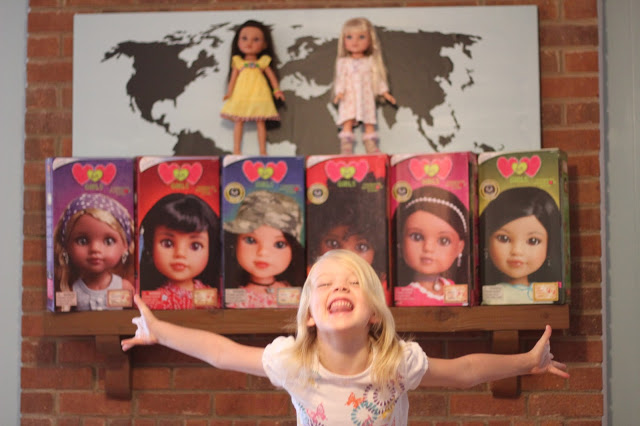
I don't intend to fully define the term here, but the response to yesterday's doll post highlights its relevance. Commenter after commenter expressed excitement about dolls that literally and figuratively broke the mold of the typical white-skinned playthings of my childhood.
When it comes to dolls, white privilege means I have a plenitude of options for products that look like me and Jocelyn and others in our ancestry.
This past Christmas, I prepared to order the darling Pottery Barn stockings I had loved for years, as I thought our family was complete. Having long loved the princess and dancer ones, I assumed I would get those for the girls... until I realized none of them resembled Zoe. From my vantage point prior to adoption as a white mother to a white children, I had never noticed the limited options outside of my reflection.
(Side note: I order my PB stocking from Ugly Sofa, which limits the selection but offers them for a fraction of the price because they are castoffs from PB when mistakes are made, like sewing "Robbie" onto the wrong stocking when completing an order. Granted, we probably won't be able to get a Patience stocking there, given the uncommon name, but I found our current five names last year with no problem. Right now, their stock doesn't include personalized stocking, but I expect them to come back closer to the holidays.)
And then we have dolls. I began my love affair with dolls from other cultures concurrently with my dreams of becoming a ventriloquist. The latter never panned out (quite possibly because I was terrible), but I only recently got rid of poor Lester, who was falling apart at the seams.
My next encounter with doll ethnicity came in college when I took American Women Authors at UNC. In addition to processing 9/11 with my classmates, as the twin towers fell shortly before class began that Tuesday and many of us - myself included - heard the news from Dr. Wagner-Martin, another firm memory from ENGL 446 was The Bluest Eye, as the young black narrator describes:
The first "black" Barbie was Francie in 1967, though she was simply a black version of the white Francie; they slapped on brown paint on the same doll made from the white mold. As such, history usually records Christie from 1968 as the first black Barbie, even though she was still made with a white doll's mold, probably Midge's. 1980 was the year when black Barbies were finally made with brown plastic (albeit in white molds and with the same hair in a darker shade). The most notable black Barbies, in my opinion, are the line of So In Style (S.I.S.) dolls launched in 2009; see some below and others here, and you'll probably notice wider noses, fuller lips, and more diverse hair types and skin shades.


Why does any of this matter?
Because dolls have always been a representation of beauty. When dolls look like us, they affirm our own beauty, and when no dolls can be found in our likeness, that beauty is called into question. After all, it is no small thing that the Bible records us as having been made in God's image. It matters.
(Another notable doll movement is underfoot for ones accurately representing kids with Down syndrome. The design takes into account not just the facial features that accompany that extra 21st chromosome but also the slightly shorter arms and the space between the toes and a few other anatomical features common among children with Trisomy 21. Read more on their website or Facebook page.)
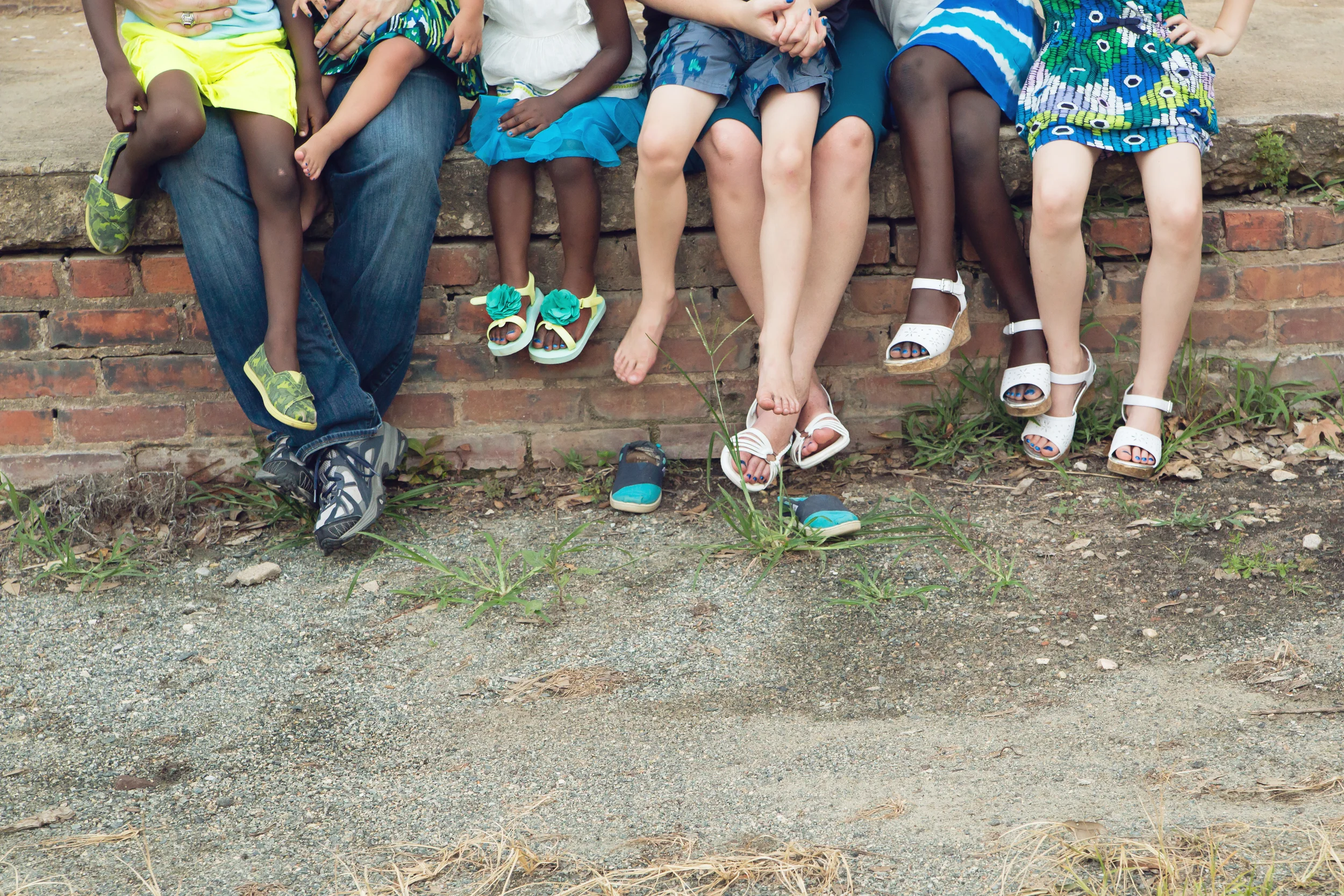
In our household, it matters more in some ways. I don't want Zoe and Patricia and Patience to think they have to have smooth, straight hair because their mother and big sister do. I can't keep them from feeling a conspicuous other-ness at times, looking different from their extended family here.
To a degree, the entire family gets in on that, as we certainly won't fit any norm in family appearances!
I can't make us more typical or match my skin to that of four of my children.
I can, however, make sure that their playthings reflect our family's diversity rather than my own white privilege.
What is white privilege?
I don't intend to fully define the term here, but the response to yesterday's doll post highlights its relevance. Commenter after commenter expressed excitement about dolls that literally and figuratively broke the mold of the typical white-skinned playthings of my childhood.
When it comes to dolls, white privilege means I have a plenitude of options for products that look like me and Jocelyn and others in our ancestry.
This past Christmas, I prepared to order the darling Pottery Barn stockings I had loved for years, as I thought our family was complete. Having long loved the princess and dancer ones, I assumed I would get those for the girls... until I realized none of them resembled Zoe. From my vantage point prior to adoption as a white mother to a white children, I had never noticed the limited options outside of my reflection.
(Side note: I order my PB stocking from Ugly Sofa, which limits the selection but offers them for a fraction of the price because they are castoffs from PB when mistakes are made, like sewing "Robbie" onto the wrong stocking when completing an order. Granted, we probably won't be able to get a Patience stocking there, given the uncommon name, but I found our current five names last year with no problem. Right now, their stock doesn't include personalized stocking, but I expect them to come back closer to the holidays.)
And then we have dolls. I began my love affair with dolls from other cultures concurrently with my dreams of becoming a ventriloquist. The latter never panned out (quite possibly because I was terrible), but I only recently got rid of poor Lester, who was falling apart at the seams.
 |
| This was Lester, may he rest in peace. (Yes, I will admit he was creepy, but I loved him.) |
My next encounter with doll ethnicity came in college when I took American Women Authors at UNC. In addition to processing 9/11 with my classmates, as the twin towers fell shortly before class began that Tuesday and many of us - myself included - heard the news from Dr. Wagner-Martin, another firm memory from ENGL 446 was The Bluest Eye, as the young black narrator describes:
It had begun with Christmas and the gift of dolls. The big, the special, the loving gift was always a big, blue-eyed Baby Doll. From the clucking sounds of adults, I knew that the doll represented what they thought was my fondest wish. I was bemused with the thing myself, and the way it looked. What was I supposed to do with it?....No, the book doesn't go on to detail a macabre attack on little white girls. But Claudia's perspective as a black child in 1941 is colored by the reality that dolls with her skin tone were conspicuously absent from store shelves. The first anatomically accurate doll like her, the Sara Lee doll, wasn't sold until 1951; even then, Macy's and Saks refused to carry it for fear of attracting too many black customers.
I had only one desire: to dismember it. To see what it was made, to discover the dearness, to find the beauty, the desirability that had escaped me, but apparently only me. Adults, older girls, shops, magazines, newspapers, window signs - all the world had agreed that a blue-eyed, yellow-haired, pink-skinned doll was what every girl child treasured. "Here," they said, "this is beautiful, and if you are on this day 'worthy' you may have it"...
I destroyed white baby dolls.
But the dismembering of dolls was not the true horror. The truly horrifying thing was the transference of the same impulses to little white girls. The indifference with which I could have axed them was shaken only by my desire to do so. To discover what eluded me: the secret of the magic they weaved on others. What made people look at them and say, "Awwwww," but not for me?
The first "black" Barbie was Francie in 1967, though she was simply a black version of the white Francie; they slapped on brown paint on the same doll made from the white mold. As such, history usually records Christie from 1968 as the first black Barbie, even though she was still made with a white doll's mold, probably Midge's. 1980 was the year when black Barbies were finally made with brown plastic (albeit in white molds and with the same hair in a darker shade). The most notable black Barbies, in my opinion, are the line of So In Style (S.I.S.) dolls launched in 2009; see some below and others here, and you'll probably notice wider noses, fuller lips, and more diverse hair types and skin shades.
Why does any of this matter?
Because dolls have always been a representation of beauty. When dolls look like us, they affirm our own beauty, and when no dolls can be found in our likeness, that beauty is called into question. After all, it is no small thing that the Bible records us as having been made in God's image. It matters.
(Another notable doll movement is underfoot for ones accurately representing kids with Down syndrome. The design takes into account not just the facial features that accompany that extra 21st chromosome but also the slightly shorter arms and the space between the toes and a few other anatomical features common among children with Trisomy 21. Read more on their website or Facebook page.)
In our household, it matters more in some ways. I don't want Zoe and Patricia and Patience to think they have to have smooth, straight hair because their mother and big sister do. I can't keep them from feeling a conspicuous other-ness at times, looking different from their extended family here.
To a degree, the entire family gets in on that, as we certainly won't fit any norm in family appearances!
I can't make us more typical or match my skin to that of four of my children.
I can, however, make sure that their playthings reflect our family's diversity rather than my own white privilege.
~+~
To learn about my favorite multicultural line of dolls and enter for a chance to win one, go here! The giveaway is live, but it ends Sunday at midnight Eastern time. (Remember: You can get more entries daily by sharing the post on Facebook and Twitter.)