HIV FAQ: Do you tell anyone at your church or school?


As long as I'm running this series, I will continue to accept questions; all of the answers will be linked together at my page on HIV. So feel free to ask another question if you'd like!

Also, several people have asked if it's okay to share my posts. YES! My blog is public, so I don't share anything here that I wouldn't be okay with a stranger reading or seeing.

Now to today's questions...
How do you handle disclosure in school (if your child is in school)?
How does the school system handle children who are HIV+? Who do they disclose that information to in order to protect the privacy of the child? 
What are your required or chosen obligations in informing the school/teachers about your child's HIV status?
Let me start by saying that only two of our six children are in school. That said, all of them are in educational programs at church, so this post will address both school disclosure and church disclosure. In other words, when I talk about teachers, unless I specify otherwise, I'm talking about all kinds of teachers: school (in our case, public school), Sunday school, Sunday evening kids' programming at church, and so on.

First, what are our legal obligations? In school, church, or childcare settings, nothing. Nada. Zilch.

Because HIV is not a risk to other children and because HIV status is protected from discrimination as part of the Americans with Disabilities Act, we are not required to disclose our child's status to anyone in a school, childcare, or church setting. In fact, we're only required to disclose to medical professionals.

(The other category that must be disclose to is sexual partners, but we're not there yet, and I'll be writing an entire post in response to questions on that topic.)

As we knew we'd be moving forward toward an HIV+ adoption but before we found out about our waiting three, one of whom is HIV+, I sat down with our school's principal and school nurse at a meeting I requested. We were trying to decide how much and to whom to disclose, and we wanted to know how they would handle a situation if another parent or if a teacher or other staff member found out about our child's status and was fearful, ignorant, or confrontational about it.

The nurse had talked to the school district's head nurse and some other higher up at the health department. They said - and she agreed - that we should absolutely not disclose to anyone. While we were thankful to add their input to the research and recommendations of other medical professionals and adults with HIV, we obviously haven't followed the specific advice about disclosure offered that day by our school nurse.

That said, I agree with her to a point: If you're not sure about disclosure, then don't disclose. You can always disclose later, but you can't undisclose. Her recommendation was based on a desire to protect our child - who was only hypothetical at that point - from the hurtful stigma and ignorance and rejection that can often be the result of disclosure.

From our principal, who is quite possibly the most supportive and helpful and professional educator I have ever met, I received assurances that our child's confidentiality would be protected and that any concerned  parties would be responded to with facts about the school's commitment to both complying with the ADA and using universal precautions (that is, treating every individual as if they could be carrying a blood-borne pathogen and using precautions with any exposure to blood).

Furthermore, she pointed out that she would not legally be allowed to disclose our child's HIV status to anyone else, even if we gave her permission to do so. In the words of the NC Bar Association,
North Carolina law makes it a misdemeanor to disclose information about HIV infection. However, there are a few exceptions. First, information about your HIV status can be disclosed with your consent. Also, as discussed above, your doctor has to report your HIV infection to the State. The State can inform your spouse. 
So do we disclose in school and church environments?

Yes. Selectively.

Actually, we disclosed long before any conversations took place. A lot of people from our church already read our blog. Some of the teachers and other staff members at our school do too. Since we have shared here that one of our children is HIV+, that means we've already disclosed - in part, at least - in those environments.

More than that, though, we do disclose to teachers now and plan to in the future, at least through third or fourth grade. Given that other children are not at risk of getting HIV from our child in a school or church setting, we are comfortable in changing that decision in the future and not disclosing to every teacher (for example, not going out of our way to tell the music teacher or art teacher, and not informing substitute teachers). As our children get older and more self-sufficient, we may shift to only informing one trusted staff member at the middle school and high school, in case of emergency, and to continuing to inform our youth pastor but maybe not every single teacher/leader. With age, we'll transition more and more about the disclosure decision to our child, as we teach each of our children to advocate for themselves.

Edited to add: To clarify my paragraph above, we don't disclose to the teachers because other kids are at risk. We disclose to them because our child is at risk for discrimination because we've chosen to go public as an HIV-affected family. It is possible that other parents at our school or church might express concerns, and I like for teachers to be knowledgeable if they're ever in that position. 

Tomorrow, I'll be posting about what information we provide in writing to our child's teachers and other caregivers to educate and equip them after we disclose.

Now, a note for potential adoptive parents: This topic, and many others I'll be addressing, just reflect our own family's decisions. Now that I'm connected to a lot of other adoptive families with HIV+ children, I am realizing more and more that the majority of families are more private about this than we are. You'll find that the loudest voices online are the ones who, like us, have chosen to disclose. Please remember that our voices aren't the only ones - just the most easily accessible ones - and don't worry that you have to be as open as we are if you decide to say yes to adopting a child with HIV. Just as my friends and I represent a variety of decisions on other topics - public schooling/home schooling/private schooling, for example - we also represent a variety of decisions about disclosure.

We've chosen what we've chosen based on our child, our school and church environments, our personalities, and a whole host of other personal decisions. Other families use the same factors to make a completely different decision.

And that's totally okay.

HIV FAQ: How do we keep other kids from catching HIV?


Yesterday, I offered the opportunity for readers to anonymously ask any question they might have about raising a child who has HIV. (That offer still stands, so go to that post if you have a question you'd like me to address.) Today, I'll be answering these questions:
"How do you keep your other kids from getting HIV+? Do you ever worry about them getting hurt because of HIV?"
 "What happens if your child is bleeding?" 
 "What about sharing things that shouldn't be but sometimes are when you share a bathroom (toothbrush, razor, towels)?"
"Can HIV be spread through spilled blood/childhood accidents? Not sure if you've addressed this in a previous post..."
I won't always group questions together, but all of these relate to one another, so it made sense to address them in one post. Before I do, though, I want to say one thing: THANK YOU! We truly want to share truth about HIV with others, and your questions are helping us do that.

Thank you. 

Now, on to the questions.
First, let's talk about transmission. HIV is transmitted through blood, semen, vaginal fluids, and breastmilk.

(Side note: I'm pretty sure this marks the first uses of the words "semen" or "vaginal" on this blog.)

(Side note about the previous side note: I was wrong. I just did a search. I used them once before in a previous post about HIV.)

For starters, we can rule out breastmilk. None of my children are lactating, so that one isn't an issue.

Semen or vaginal fluids? Nope, our children don't share that either. Even if trace amounts were left behind, it wouldn't be possible for infection to occur via shared toilet seats or (ew, ew, ew) shared underwear.

(Side note: I do not condone the sharing of underwear.)

So we're left with blood.

In order for HIV to be transmitted, blood-to-blood contact is necessary, such as blood transfusions or shared needles. That's not something done among our kiddos either.

As far as childhood accidents and spilled blood go, HIV has never been transmitted in those ways. Never. We still use gloves when dealing with blood, and we're a bit more liberal with our band-aid usage now to keep all wounds covered, but? Those are just precautions. HIV hasn't ever been spread in a normal childcare, school, or household environment. It's a wimpy virus that dies very quickly once exposed to air, so that's why lists about transmission risk focus on blood transfusions and needle sharing: blood from an HIV+ person that has not been exposed to air (by being in a needle or by being in sterile tubing/bag for transmission) has to enter the bloodstream of another person for transmission to occur.

Don't want to just take my word for it? Here's a quote from the New Mexico Department of Health:
Whilst HIV may live for a short while outside of the body, HIV transmission has not been reported as a result of contact with spillages or small traces of blood, semen or other bodily fluids. This is partly because HIV dies quite quickly once exposed to the air, and also because spilled fluids would have to get into a person's bloodstream to infect them.
Other citations and HIV facts can be found in this post.

What about shared razors or toothbrushes or towels? For starters, towels pose no risk. Kids can share those with no problem. Razors and toothbrushes are off limits for sharing because blood is sometimes present due to bleeding gums or cut skin, so we do stress that... but the only cases of transmission from those were between siblings with hemophilia whose bleeding was profuse and whose HIV was uncontrolled, leading to a rare perfect storm of circumstances for transmission to occur. That hasn't happened in more than 20 years, and doctors expect that it wouldn't have happened in the absence of hemophilia. That said, sharing of razors or toothbrushes is considered a "low risk" (rather than "no risk") activity, and we treat any risk - no matter how unlikely - as serious.

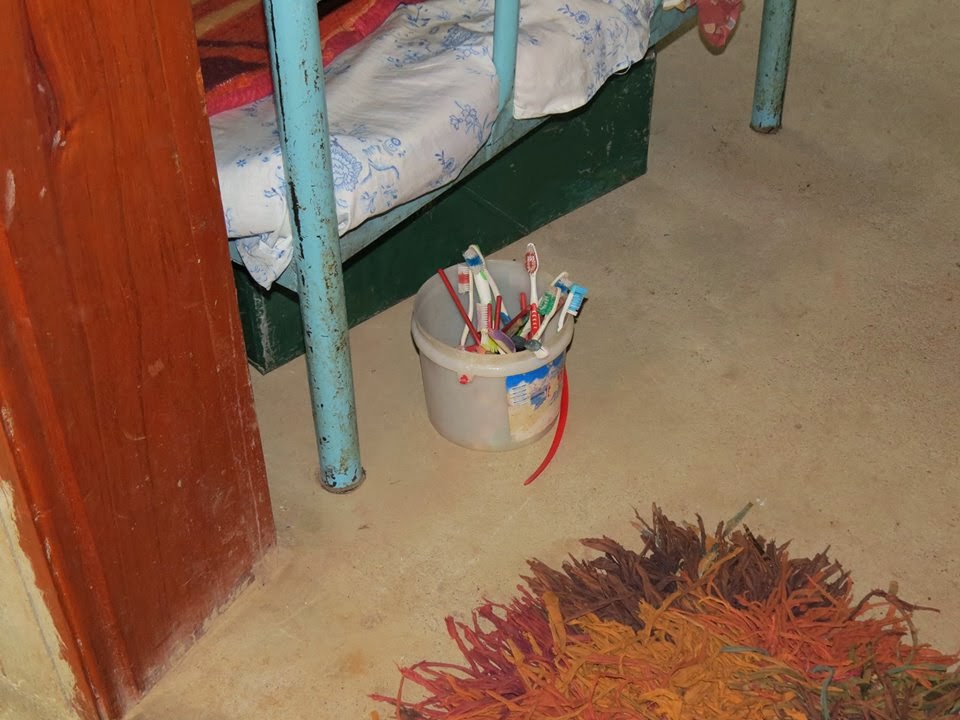
But consider for a moment the setting our newest three children lived in before they came to us. The orphanage was hardly a sanitary environment. Sharing toothbrushes?


Yep, that's the communal bucket of toothbrushes. No one had their own, and the orphanage had more children than toothbrushes; in other words, a whole lot of toothbrush sharing occurred. 


Our child was the only one there with HIV.

None of the other children contracted it.

So while we certainly take precautions in our own home, we know our child has been in far less sanitary conditions without transmitting HIV. In fact, there's no record of HIV ever being shared among children in any orphanage setting, which to me is even more compelling than the fact that HIV has never been transmitted in normal home, childcare, or school environments.

Which leads me to the last question: Do we worry about our other children being at risk because one child has HIV?

No.

Our child with HIV is at a greater risk than our other five. Why? The other five could bring home all sorts of germs and ick, and while their bodies can fight viruses and bacteria, their sibling's body can't. Even so, our child is growing stronger and healthier each day with the daily medication regimen we adhere to, which means immune system function is improving as the measurable amount of HIV present in the blood is diminishing.

(Side note: that also makes the risk of transmission much lower, as the presence of HIV in my child becomes less and less.)

As we say at medication time twice a day, "This makes you strong and healthy."

And it does.

Praise Jesus for modern medicine!

what would YOU like to know about raising a child who is HIV+?


I'll be writing a new series of posts about HIV now that we're home and settled into our groove.

(If you're a new-ish reader, go to the navigation bar above and pick "HIV" under "diagnoses" for our backstory on this.)

For now, though, I'd like to provide the opportunity for anyone to ask a question anonymously. I'll do my best to answer all the questions in future posts! Truly, HIV isn't a huge looming boogeyman in our lives... and I'd love the opportunity to make it a bit more normalized by answering your questions, because I don't want ignorance to force kids like mine to live with stigma or to condemn orphans with HIV to lives without a family.

living with HIV

One of our precious ones has HIV.

It's a daily part of our lives. At 7:30am and 7:30pm, we dole out meds (currently, in Mary Poppins fashion, with a spoonful of sugar) to the child who needs them. These medicines keep the viral load so low that it's almost undetectable in blood samples. It's not a cure, but it lets our kid be a kid, playing and giggling and wrestling and running like our five children who don't have HIV.

For now, since we can't untell - especially online - about this diagnosis, we're not disclosing which child is affected.

{Honestly, because we're all a family, you could say we're all affected, even though only one of us is infected.}

I'd like to say it's a non-issue, but some friends and family members have faded away. Some have said they won't be coming over anymore. Some have said their kids can't play with our kids.

I'd like to say it doesn't sting each time, but it does. 

Oh, does it sting!

Want to know what would sting more, though? Knowing that we had the opportunity and felt the pull toward HIV+ adoption, but choosing to do nothing out of fear for what people might think about us. My heart aches with each rejection of our child or family because of three letters, but it would ache more if I had chosen the comfort of our old friends over the call to stand up for a child who didn't even have the comfort of a family or the hope for a future, given the lack of access to medical care prior to adoption.
For am I now seeking the approval of man, or of God? Or am I trying to please man? If I were still trying to please man, I would not be a servant of Christ.
{Galatians 1:10}
Our regrets about HIV+ adoption? None. 

We have none.

What do we have? A child who we love, who has changed our lives, who we've gotten to see emerge from the grasp of an illness that was destroying a little body but is now kept at bay by our amazing medical team at Duke. 

(And you know they must be amazing if a mama who graduated from UNC and a dad who hails from NC State can love them!)

We have much more than we ever had before HIV entered our lives, because while HIV is the diagnosis, our child isn't a diagnosis. Our child - and the two siblings we adopted at the same time and the three children we had before that - are simply children.

Precious, darling, energetic blessings.

One of whom happens to take medication twice a day.


~+~
If you'd like to know more about HIV adoption, check out the posts below:


This is life with HIV. Doesn't look so scary now, does it?

seven years ago

I was trying to figure out how to nurse my baby girl.

My body was recovering from childbirth six days before.

We were closely monitoring our little one's weight with regular check-ups.

On the other side of the world, another mom was starting the same process, having given birth the day before to her first child, also a baby girl.

She fed her.

Her body recovered.

She and her husband did all they could to ensure her health.

Unlike me, though, she didn't get to celebrate the seventh birthday of her big girl.

As we cheered our precious girl turning seven yesterday, I couldn't help thinking of her first mother. In a perfect world, children would never need a second family. In the absence of disease, some of my children would never have become mine. While I am so very blessed to be their mother, I grieve too, because if our world was as it was in the Garden of Eden and as it will be in heaven, then I would never celebrate the birthday of a child to whom I didn't give birth.


Sometimes, in adoption stories, we craft the pre-adoptive history as dismal and post-adoptive stories as redemptive.

Sometimes, this is fair.

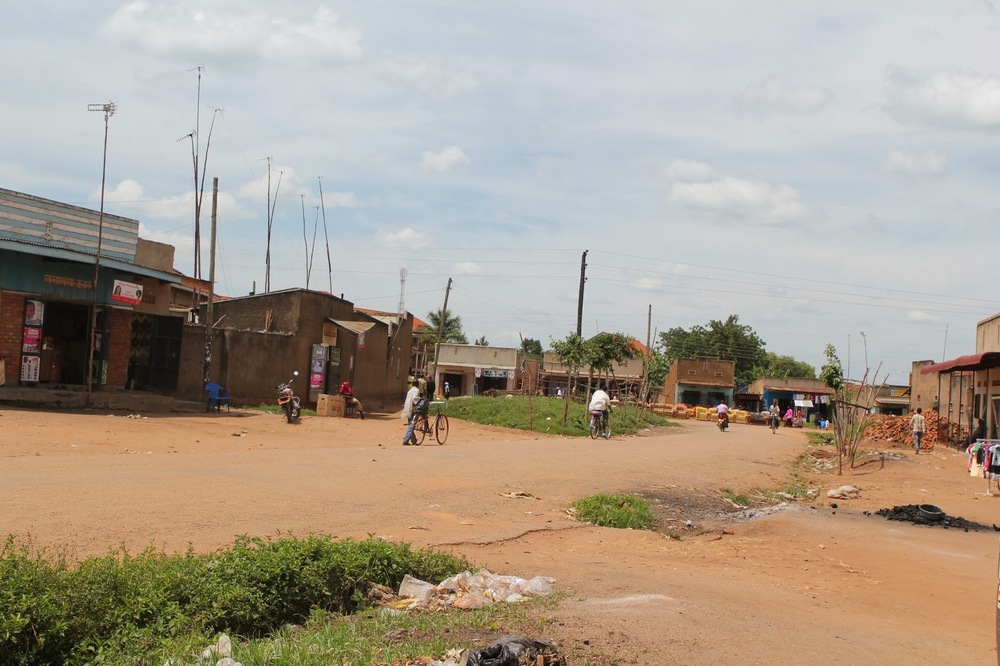
Most times, though, the pre-adoption stage had its own beauty. Just look at the common courtyard of the apartments where our newly seven year old daughter spent her days before their first family fell apart.


Such beauty.

It's easy to glorify adoption.

But seven years ago today, another mother nursed her baby girl and expected her to walk these roads along with the rest of their family, including the siblings who would come.


I'm sure she never expected that her daughter would be going out to a birthday dinner at a restaurant in America seven years later, traveling different roads with a different family.

For the opportunity to raise her daughter and the two siblings who would follow, I am thankful.

But I'm a mother too, so I am also grieving over the hard realities that required another family - our family - to raise her children.

I hate that.

But I love this.


Such are the paradoxes of adoption.