HIV FAQ: Is there a cure yet? I heard there was.


I expected this question would come up, as we hear it in person about once a month or so:
I've heard they have discovered a cure for the HIV virus, is this true?
No.

But I do think it's getting close. Next week when I answer questions about dating and sex, I hope they'll be answers that I'll never have to actually use. I hope a cure is found because our child is old enough to be considering what high school and college are like with HIV added to the mix.

That said, we adopted with the expectation that HIV would be a lifelong reality for our child.

But how awesome would it be if it weren't!

A Google news search for "cure for HIV" came up with nearly 9,000 results today, dozens of which are from the past week. In other words, those of you asking this question aren't the only ones talking about a cure for HIV. Unlike the other diagnoses represented in our family, HIV has a lot of visibility.

Usually, visibility = research dollars, so that's a good thing.

The two cases most people are referring to when they say they've heard about a cure are the one about the Mississippi baby and the one about the blood stem cell transplant patient known as the Berlin patient. From what I understand about the Mississippi case, the child was treated aggressively and immediately upon childbirth, and no other cases have been attempted; even if it could be repeated, it would only be a cure that would work for newborns and not for older patients. As for the Berlin patient's case, it's not been able to be replicated, so while it seems that the guy's HIV is gone, it's not a cure that has been able to be applied to other patients.

Or sometimes people are talking about kids like our friends' daughter. Courtney and Andrew adopted her, knowing she tested positive for HIV. Now she doesn't. Is she cured? No. She tested positive initially because her mother's HIV antibodies were still in her system. So it's not accurate to say she was cured (though we're rejoicing that she isn't HIV+!). It's more accurate to say that her initial testing gave a false positive because of her mother's HIV.

I am optimistic for a cure. It just hasn't been found yet.

But, whether it comes in our child's lifetime or not, we're thankful for the blessing of parenting each of our darlings.

i'm sorry if my kids teach yours about hunger, abuse, poverty, disease, and other ills

A friend and I bantered on Facebook earlier today and ended up discussing the limitations on understanding someone's tone via the Internet. With that lesson in mind, I want to be up front about the tone of this post: it isn't sarcastic. It's sorrowful. And truly apologetic. 

As I pray for each of my children, in light of their backgrounds and our trip to Uganda, I want you to know that I pray for your children too. 

Why?

Because I grieve over the innocence Jocelyn and Robbie have lost as they hear the before-adoption stories from their siblings. And I grieve over the innocence your children might lose in the same way.

Is it worth it? Yes.

Is it good for our children to learn about suffering? Yes.

Is it helpful for us to guide them through it so they learn to suffer well? Yes.

Is this the fun stuff of parenting? No. No, it's not.

I don't want to have hard lessons taught to your children or my first two children by our newest children. I know you don't want that either. For that, I am sorry.

But as I apologize for the stories of hard things that your children might hear, I grieve even more over the experience of hard things for my children who lived it firsthand.

When our oldest started showing extreme anxiety when we got home from Uganda, it was because she had difficulty reconciling a return to our comfortable lives here with the extreme poverty she witnessed there. 

When another starts obsessively cleaning because she thinks we might abandon her if she isn't good enough, it's because she knows what abandonment feels like.  

When one of ours hides toys and snacks in a backpack at the foot of his bed, it's because this child knows what it's like to be without food or trinkets.

When our wild boy asks if we're going to start beating them when they misbehave, it's a response to the stories of beatings he heard about or saw at the orphanage.

When one dear one got extra clingy this week when I took to bed with a nasty cold, it's because she knows what it's like for her mother not to ever leave her sick bed.

When our baby girl spikes a fever with her cold and we have to go to the doctor immediately, it's because the malaria she had while in Uganda could have lingered and reactivated and we have to get a quick blood test to make sure it hadn't. 

Oh, my heart. Sometimes it's too much for this mama to bear.

my children know what it's like to watch other children scavenge through the trash for food
they can't unknow that, as much as I'd like, and neither can I

So please forgive us if our children teach yours about hunger, abuse, poverty, disease, and other ills. If that does happen, please pray for our children too as you pray for yours to heal.

And know that I've already been bathing yours in prayer, knowing that I couldn't protect my dear ones from the harsh realities of this world and I can't protect yours either.

Sweet Jesus, come soon.

HIV FAQ: What about the medical treatment, expenses, and prescriptions?


This topic has received more questions than any other:
What is the extent of medical care involved in adopting a child with HIV?
Is affording the medication manageable? 
 Are you going broke on the cost of the meds?
 How expensive are the medications? How often do you have to purchase them?
How often does your child have to go to the doctor?
How many medications is your child on?
Will they be on the same medications/amounts for their entire lives or will the types of medicine and amounts change as they grow and change? 
This question come up a lot in adoption, particularly special needs adoption: What about the costs? When a child is born to us, we can't foresee what medical expenses they'll have or when an ER trip will hit or how many times they'll have to see the doctor. We say yes to those uncertainties, not knowing if the expenses will run high or low or average.

We say yes because we deem our biological children to be worth it.

We say yes because they're "our flesh and blood."

We say yes because we'd never think of saying no.

It gets dicier once we're talking about adoption, especially in the early stages. Before you know a child who is waiting for a family, you can't see the humanity that comes before a diagnosis. Checklists on adoption agency forms ask which special needs you're open to. While my friend Amy Julia can write elegantly about using first-person language when speaking of Penny, her daughter with Down syndrome, it's a lot harder to put the child first and the diagnosis second when the adoption is still hypothetical, with the child feeling that way as well.

In adoption, we can say no.

And when we say yes, we have the opportunity to prepare more in advance, at least for the diagnoses known prior to the adoption.

It strikes me that these questions are actually coming from two different camps, so I will answer them in two ways. First, for those who are asking to know - out of curiosity or medical interest or adoption consideration - the bare bones details of the medication and treatment regimen, here's the answers:
  • Doctor visits: We have a great pediatric infectious disease team at Duke. At first, we saw them once a month. Labs are looking so good now that it's every two months now. It will stretch longer as time goes on, first to every three months and then to every four months. In adulthood, it will likely be every six months. 
  • Lab tests: The main ones are CD4 counts (measures of how strong the immune system is: the higher, the better) and viral counts (measures of HIV in the blood: the lower, the better, with the goal to reach undetectable levels).
  • Medications: Meds are given every 12 hours. In the morning, it's two half pills. In the evening, it's two half pills plus two capsules (which are the same med but two different quantities). So it's three medications given via four half pills and two capsules over a 24 hour period. At the orphanage, children either took their meds or received a beating, and no one taught our dear one how to swallow pills, so our child has the habit of chewing each pill. Dosages and medications will be adjusted as our child grows and develops. 
  • Costs: Over Thanksgiving, we had to pick up a refill. We talked with reps from our insurance company, with our pharmacist, and with a few other folks, making sure everything was in order. They all said it was. Come the day after Thanksgiving... nothing. The computerized insurance processing system at the pharmacy said our child wasn't insured. We had to pay out of pocket - though it was later determined that the insurance co. was at fault and we were reimbursed - a total of about $950 for a month's worth of medication. On a monthly basis, though, the costs are no different from any other prescription on our plan. In fact, insurance companies treat children who are adopted as if they were born biologically into the family: no conditions are considered pre-existing or exempt from coverage. It's as if our child was adopted in perfect health and only later contracted HIV. We are required by our insurance company to have the meds sent via a mail order specialty pharmacy, and they send three months worth at a time. Various state-led programs and pharmaceutical companies offer ways to reduce costs of HIV meds, but we haven't needed that help. 
  • Side effects: None, so far. One makes our precious one tired, but that one is given at nighttime, so it doesn't have any ill effects. 
For those who are asking less about the logistics and more about the stress of all the medical stuff, it's not a big deal. Yes, medication is part of our routine. But it is now perfectly routine for us, not out of the ordinary or weird or anything like that. 

Sure, managing HIV is part of our lives, but it's a small part. 

And it's absolutely worth it.

seizures are scary

When we adopted Zoe in 2012, we knew the odds were high that she would have seizures. Given the locations of the brain damage causing her cerebral palsy, epilepsy is a common co-diagnosis.

So it wasn't completely unexpected when we had to call 911 during a massive grand mal seizure only four months after flying home with her from Taiwan.

What was completely unexpected? The child seizing... it wasn't Zoe.

It was Robbie. 

Robbie, who had no indications for epilepsy, seized for more than 15 minutes before the paramedics stopped it with meds.

Robbie, who was typical in every way until then, spent Thanksgiving in our local children's hospital.

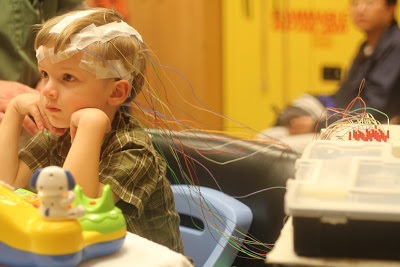
Robbie, who always slept well, had an EEG that showed abnormal activity during the first few hours of sleep.

His eventual diagnosis was Benign Childhood Epilepsy.

We were told another seizure would come.

We cried.

No, that's not quite right.
We sobbed.

We rarely slept, waiting for the next seizure.

I started anti-depressants.

It was more than we could bear.

But God.

He was faithful, and He brought friends alongside us through tests and with coffee and in mingled tears.

Since that first one, Robbie has had some partial seizures but no more grand mal ones. We've been on and off a few different meds, but he's been med-free for a year now. We've found his seizures to be so rare and manageable that it's not worth medicating him at this point.

We'll revisit that as he grows, and we'll hope that his doctor is right in expecting him to outgrow his epilepsy around adolescence.

Which probably makes me the only mama who is looking forward to her little boy hitting that stage.

And we'll pray and trust.


~+~
If you're interested in our posts about epilepsy...

The story of his first seizure:

his diagnosis

on trusting God with epilepsy
hallelujah, all I have is Christ

on aiming for routine to avoid partial seizures
hoping to find a pattern to our lives again

on having an EEG as a small child


hoping to find a pattern to our lives again

I haven't blogged about epilepsy in a while.

That's because it's been a non-issue. During Thanksgiving break of 2012, Robbie had one grand mal seizure. Several partial ones followed in the next few months. We tried a couple of different meds with little success and then shifted gears, focusing instead on trying to normalize our routine such that his neurological stress was limited.

And it worked.

We knew, when we said yes to this latest adoption, that we might have seizures again.

I thought, if they came, we'd see them in Uganda. As he struggled through jet lag and stomach issues and family changes, I was certain his brain would be thrown out of sorts.

It wasn't.

At least, not enough for seizures.

But all the changes in the home life here, plus snow days throwing off our daily routine, have proven to be too much in the past few weeks.

The partial seizures are back.

For him, it just means that he spaces out and loses control of his bowels.

Eh. With two in diapers, why not a clean up a third from time to time, right?

We're working to bring normal back. To get the house back into order, as mess stresses him. To stick to a set routine of carpool-gym-playtime (while Zoe has therapy)-lunch-rest-carpool-walk/bike/scooter-TV (while big girls do HW)-dinner-bath-books-bedtime, as changing up the routine stresses him. To make sure he gets one on one time with Mom, as missing that stresses him.

We're praying we can get it all under control before summer starts, keep it under control through the summer, and then help him settle into a new routine in the fall with the start of school.


As we aim for a low stress environment for him, we're also doubling our efforts (ahem, bribery) at retraining his brain to use the toilet... which brings me to a rather funny story from the other day, which seems like a fitting end to a downer of a post.

Robbie ran into my room, where I was resting with a head cold, and said, "Mommy, I went in the potty. Can I get a new squishy reptile now?"

I replied, "Good job, buddy. But once isn't enough. I need to see a pattern."

His response? "Dinosaur, snake, dinosaur, snake, dinosaur, snake, dinosaur, snake, dinosaur, snake, dinosaur, snake, dinosaur, snake, dinosaur, snake, dinosaur, snake, dinosaur, snake, dinosaur, snake. Like that?"

Oh, dear boy. 

The electrical activity in your brain might be a bit out of whack, but your sharp wit is surely intact.