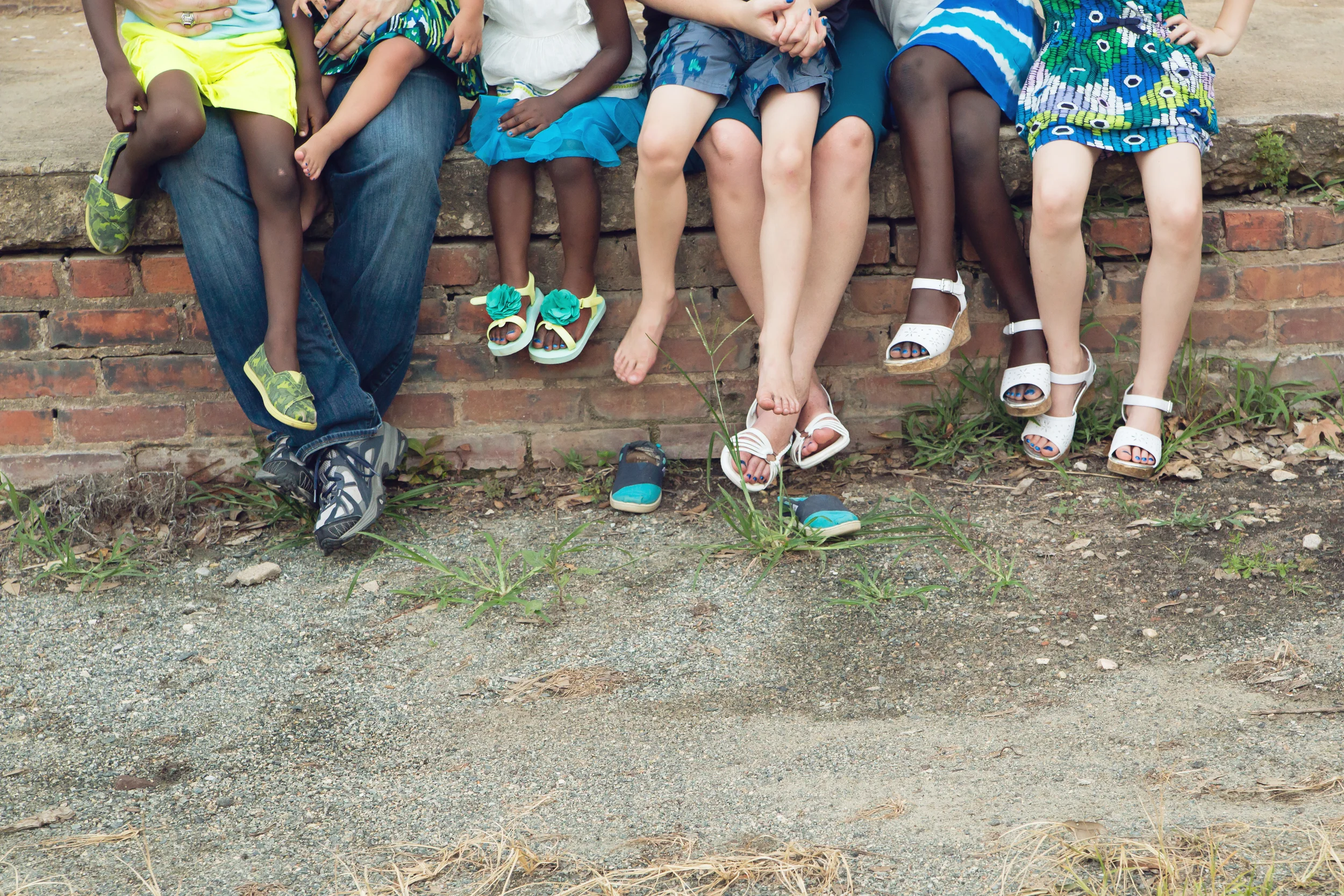
why I press on when I can hardly bear it {on #Ferguson, Ebola, & my own racism}

Y'all, some days I just can't even bear it.

As much as I love technology, lately I've found myself longing for the days in which it didn't exist and I wouldn't know about another unarmed black man being killed or the loss of another life to mental illness or the death of more people to Ebola or the persecution of many people groups (including, but not limited to, Christians) in the Middle East.

But we need to know. 

Let me step back for a moment, though, to share a different story, one from my small life that I think fits in the context of the bigger stories being discussed today.

Two weekends ago, a rainy Saturday morning found our family at Monkey Joe's. We had our Groupons printed and our socks on, and our party of eight was all set for bouncy house fun. As we pulled up, though, I felt my chest tighten as I noticed that everyone else in the place had much darker skin than I do.

I hate to admit this, but I thought, "Next time, we'll go to the one in Cary."
You know, the whiter suburb.

But we unloaded and filled out waivers lest my crazies ended up injured and tucked our shoes into cubbies and let loose. And as our time in that packed play place wore on, I was convicted.

As I chatted with the black mama sharing our lunch table, sharing words in between pages she read on her Kindle, I was convicted.

As I saw my children light up when they pointed out other little boys and girls who fros and twists and mohawks like three of our children were wearing, I was convicted.

I was convicted and ashamed as I realized the assumptions I had made, the ingrained attitudes I felt, and the judgments I passed about a group of people who mostly resembled three of my children more than me. As I shared with a friend in response to the events of Ferguson, Missouri,
"I thought I understood, but I didn't. Not until I became a mama of a black boy who will one day - God willing - grow up to be a black man. Stories of Trayvon and Michael Brown and John Crawford and others like them mean more to me now, and I'm ashamed that they used to mean less. I know many mothers battle anxiety about the future for their kids, but that's never been a temptation for me... until raising a black boy and having my eyes opened to so much of what that involves. Oh, my heart."
The next time we go to Monkey Joe's - after all, we have at least 2 more trips of Groupons to use - it will be that location again. Next time, I will see the beauty in diversity and the blessing in differences. Next time, I will know better and be better because I was willing to let God convict me of an ugly part of myself where racism and prejudice dwell even though I'd like to say I'm better than that.

I'm not.

I don't think any of us are.

When I think about Ferguson, I can't help but think about the Ebola outbreak in parts of Africa. What does it say about us that few people here knew or cared about the deaths in Liberia until the virus was contracted by someone who, for many Americans, was raised like us and believes like us and looks like us and has the same passport as we do?

Does a white life matter more than a black one?

I've been following the outbreak for a few months because of a friend in the area, but Ebola didn't break into my news feed until a white Christian American got sick. I'm uncomfortable with that, because my God cares just as much for the sick Liberians.

God cares as much for my black son as He does for my white one,
my son from Africa as much as my son from America.

photo of my boys by Rebecca Keller Photography
He loves them both.

And so do I.

On the days when I can hardly bear it all, I press on for them. And I write on for them too, even owning my own ugly places, in hopes of making the world - and myself - a better place for them.

Undetectable: The word every HIV affected person loves to hear

A couple weeks ago, while seeing our child's pediatric infectious disease team, we received wonderful news: UNDETECTABLE. In the latest blood test, our child's HIV viral loads were undetectable.

Undetectable. 

This is the goal of treatment, I know. But knowing that intellectually is very different from feeling it emotionally when you see the lab results and hear the word. Glory.

Most readers of this blog aren't members of an HIV affected family, so let me back up a bit to explain. The two blood tests for HIV are CD4 counts and viral load counts. The first measures immune system function, the higher the better, while the second measures the number of copies of HIV per milliliter of blood. When our child came home, that CD4 count was dangerously low while the HIV count was high. Over time, the CD4 count has been improving as our child gets stronger and healthier, and the viral load has been dropping.

And now? UNDETECTABLE.

We don't have to been seen again for a few months, but the nurse calculated a next weight benchmark for medication adjustment because our child might gain enough pounds before our next appointment to warrant a dosage change. HIV can, among other things, stunt growth, and that was true for our dear one. Reaching undetectable viral loads means a major growth spurt is right around the corner.

Technically, undetectable means - at our lab - less than 40 copies of HIV per milliliter of blood. But to give you some scope of what that means beyond the anticipated growth spurt, here's a snippet from a news story on the reported findings so far of a multi-year study of sexually active serodiscordant couples (that is, couples in which one partner is HIV+ and one is HIV-):

When asked what the study tells us about the chance of someone with an undetectable viral load transmitting HIV, presenter Alison Rodger said: "Our best estimate is it's zero."

In this study, undetectable is defined as less than 200 copies of HIV per milliliter of blood, whereas our lab's definition is a little stricter. In two years so far in the study, the 1,100 couples have recorded 44,400 instances of unprotected sexual activity. In those 44,400 encounters, the only precaution against HIV transmission was the HIV+ partner taking ARVs and having undetectable viral loads, just like our child. The result? No transmissions of HIV occurred among those couples as a result of their sexual activities.

None.

Our child wasn't a threat to any other child before reaching undetectable viral counts, because HIV is only transmitted by sexual activity, breastfeeding, or shared blood, as in transfusions or reusing syringes. Childhood accidents and spilled blood have never transmitted HIV - not in a home environment, not at school, not on the playground, not in the NFL or NBA or any other sports environment. But eventually our child will become sexually active, so this latest research is very good news to us, especially in light of our child's undetectable viral loads.

So what do we do now?

We'll continue to stick firmly to our child's medication regimen, because that's what will continue to suppress the viral load. We'll keep sharing the truth about HIV, in hopes that the world will be a less ignorant place by the time our children are adults.

And we'll celebrate, because undetectable is definitely worth celebrating.


I love my modern village.

Just this week, I've seen a HuffPost Parents piece pop up again and again in my newsfeed, lamenting the loss of village-style parenting in our modern world. To that, I say, "Hogwash."

Even if we assume that the village always functioned in the romanticized manner she described, I'm happy to wrap myself in my online village. In that archaic village, for starters, I wouldn't have the rich opportunity to connect with as many families like mine: transracial adoptive families (and adoptees or first parents who round out the adoption triad), special needs families, other parents with HIV+ children (in private groups I can't link to, for the sake our our children's protection), and so on. Our daughter Zoe will have a potentially life-changing surgery in St. Louis in October, and I would never have known about that from a local village without more global connections. Furthermore, she and I will stay with one online friend and her family while we're in St. Louis, and we have a back-up option with another Facebook friend.

I promise, Mom, these friends are safe. Don't worry!

Beyond that, though, I know I'm not alone in making a mothering village out of Facebook. Just as the HuffPost blogger wrote about "doing the washing side by side, clucking and laughing hysterically, tired in body but quick in spirit," I find myself checking in online with other mamas, near and far, in between filling my modern washer and dryer (which, after washing by hand for six weeks in Uganda last fall, I will not take for granted again). Even as I get frustrated at times at all the lack of listening and lot of yelling online, I don't buy that those same behaviors wouldn't be present in the village too, even if they would be much less public.

Here's how my village works. I posted, with great vulnerability, what I was feeling on Monday without any pretense or facades.


What happened? My online village rallied with likes to affirm that I wasn't the only one and comments, messages, and texts to encourage me in this mothering work. A fellow mama of many whose youngest is about to turn 18 asked if she could bring me Starbucks and then stayed to join in the sorting, folding, and hanging of little girl and boy clothes, making heaping baskets seem far less daunting as we tackled them together. A couple friends asked if we needed food (after all, that's how we show love here in the South) and  another - after seeing a couple posts on Instagram about our summer colds - offered to run an errand or two if that would help.


Does Fakebooking happen online? Yes. Does wearing a mask and pretending all is well and then crying in the confines of your own house or hut or tent happen in the village too? Yes.

Community doesn't have to be the village. Community can be an online forum or a group of adoptive parents at a guest house in Uganda or the passing conversations in the halls of the elementary school as we meet the teacher and drop our children in classrooms and head off to homes or jobs or the discovery of who we are as women after the years many of us spend primarily as moms with little ones underfoot until they're school aged and we're not quite sure how to fill our days without those grubby hands ever present. Community is a homeschool co-op or a Bible study group or a series of group texts. Community can be Twitter or Facebook or blogs, and community can be coffee shops and laundromats and mealtimes.

I refuse to buy into the notion that present day villages can't be made, that community evaporates in the presence of doors that lock and machines that wash clothes and other modern conveniences, and that today's motherhood has to be as isolating as that HuffPost blog writer describes.

What would our parenting experiences be like, I wonder, if instead of wistfully waxing about the village of days past, we chose to create our own modern villages using the technology from afar and touches near that this day and age has to offer?

"horribly devastating?" no. a life worthy of love.

We're coming up on the two year anniversary of our trip to Taiwan to meet Zoe and finalize her adoption and return to the US to join with Robbie and Jocelyn as a family of five.

Expect loads of "two years ago today" posts on Facebook and Twitter, thanks to my addiction to TimeHop.

What I've been reflecting on lately, though, isn't what happened two years ago but how much God has used Zoe's arrival in our family to shape me and Lee. I don't talk about this part of her story much, but her records from Taiwan were pretty hopeless looking. Upon reviewing her MRIs and medical reports from Taitung, several prominent neurologists around the country agreed that she had little potential to move, think, or communicate like a typical person. Why so many doctors looking at her file and weighing in? Each one did so for different families who each subsequently passed on the opportunity to adopt the baby girl called "Jesse" back then. The last doctor to review her medical information recommended against her adoption, saying she would be "horribly devastating" given how extensive her brain abnormalities were and how all-encompassing her cerebral palsy would be.

Yes, that little girl in the middle right there:


I'm flooded with adjectives and emotions to describe her, but "horribly devastating" is not one.
Not even close.

Many of you know this story already, but it bears telling again. On the eve of Jocelyn's fifth birthday, a friend sent me a Facebook message. She knew we planned to adopt a child with special needs someday, and she tripped over her words a bit as she shared about a baby girl in Taiwan whose future was unpredictable and who needed a family. We said we'd pray about it, not because we intended to pray about it but because we thought that was the church-y answer to give instead of saying no right away. It was a Saturday night, and we planned to reply on Tuesday with a list of reasons why we weren't her family. "We'll pray about it" was merely a stall technique and not an honest answer.

Then on Sunday or Monday night, Lee rolled over to me in bed and said, "Maybe we should actually pray about it, because we said we would." He quickly followed with, "I mean, I know the answer, but..."

So we prayed.

And God moved our hearts from a hyper-focus on all the reasons it didn't make sense to an assurance that our small faith in a great God was enough to say yes, even when the answer didn't seem to make sense.

You know the rest of the story. It led to a tiny prayer room in a hospital in Taitung where we met a very ill eight month old who was discharged from the hospital into our care a couple days later, to fly to Taipei for her visa and then through San Francisco to land in Raleigh, meet her older siblings, and then head to see US doctors within hours of our arrival.

Jet lag, I'm certain you had those doctors thinking we were INSANE. Because we were, kind of.

But I like to think we're the best kind of crazy.

As a response to the doctor's condemning words and the heartbreaking reality that many families had said no before she crossed our paths, we chose a name for her that would speak truth: Zoe Amanda. Zoe means life, and Amanda means worthy of love, and really, truly, absolutely she is a life worthy of love.

What one doctor described as "horribly devastating" is one of the greatest blessings we have ever known. I don't have the time to list them every way she has improved our lives, but our days are richer, our faith is deeper, our mealtimes are funnier, our circle of framily is wider, and our world is better because we said yes to God when He led us to her.

I'm always caught off guard when people say that she's lucky. She's not, y'all. It's us.
We're the lucky ones. 

three reasons why families with #specialneeds opt out of VBS #SpnMin #kidmin #church #inclusion

We're full swing in Vacation Bible School this week at church, and as I'm the director for special needs inclusion and a mom of a child with cerebral palsy, I'm reflecting a lot about why many families whose kids have special needs are absent from VBS (or "Super Summer Adventure" as our church calls it).


Why do some families like mine opt out of VBS?
1. You never gave them the opportunity to opt in.

I know you pour your heart and soul and time into VBS planning each year. Truly, I do. I've done it myself. But as you plan the stories and crafts and schedules and games and songs and so on, did you stop once to think, "How will this work for kids who think or behave or interact or communicate or move differently from typical kids?"

If you didn't, then you haven't proactively considered families affected by special needs, because disabilities affect one of those areas of development. And if you're not planning with kids like theirs in mind, then you're unintentionally saying, "Our VBS is only for kids without special needs."

I know that hurts to hear, because you are working so hard to plan an awesome week for all those typically developing kids. But it hurts even more for those parents to hear the message you're accidentally communicating, which is that church is not for their child.

Tip: Next year, reach out to families affected by disability in your church (or, if none are currently at your church, in your community) and ask them to be involved in the planning stages so you can be more thoughtful. Also, trust me when I say that one-on-one helpers for kids with special needs who need that support are just as crucial to an inclusive VBS as class teachers; your volunteer roles might need to be a little more diverse to include our families well.


2. A lot of kids with special needs don't handle new environments well.

Even if your church is their usual environment on Sunday mornings, VBS is different: Louder. Longer. Busier. Bigger. Maybe at a different time or in a different part of the church than other children's ministry programming. During summer, which is already a time in which family routines are thrown off and kids are often in a state of major dysregulation.

Simply put, that's hard for a lot of our kids.

Tip: Respect that some of our families, just like some families with typically developing kids, will happily opt out of VBS without any hurt or hard feelings. For those who want to come but feel like they can't, offer two helps: (1) invite the family and child to walk through VBS before it starts, either by physically visiting the church beforehand or by sharing a social story - with pictures of each area if possible - that describes step by step what will happen from the moment the child arrives until the moment he or she is picked up and (2) let families know that they are welcome to try it out without any expectation that their child will come for the entire week.


3. Kids with special needs often have full calendars already.

Let me share what our week looks like during VBS:
  • Every morning: Arrive with my six kids at 8:45(ish), take them to their classes, and then go serve the other kids I love.
  • Monday: Pick Zoe up at her class at 11:15, drive home for her physical therapy at 11:30, check in with Lee to make sure he has all the room numbers to pick up our other five when VBS ends at 12 noon during his lunch break from work, and welcome our other kids home around 12:30 as our therapist is heading out.
  • Tuesday: Pick up all the kids from their classes at 12 noon, have one of the big kids feed Zoe a light snack/lunch in the car, arrive home to put her down for a nap, do lunch for the rest of us, and then wake Zoe up for another snack just before speech therapy at 2:45, which I had to reschedule with the therapist since it usually would have been smack dab in the middle of Monday's VBS time.
  • Wednesday: Same as Monday.
  • Thursday: Pick up all the kids from their classes at 12 noon, have one of the big kids feed Zoe a light snack/lunch in the car, arrive home just in time to meet our occupational therapist at the house at 12:30, and feed the rest of the crew while Zoe has OT.
  • Friday: Same as Thursday, except it's speech at 12:30 for Zoe and then Robbie (once again, at a rescheduled time because our usual time conflicted with VBS).
It's totally worth it for us, but IT. IS. EXHAUSTING. For many families like ours, it's not worth it or even feasible.

Side note: Local friends, forgive me if I disappear next week. I think we all might need some time to recuperate and regroup after this very fun but very full week!

For some families, their child's educational special needs have them in a school setting during the day even when other kids are out for the summer, which might conflict with a morning VBS. For other kids, medication wears off by the evening or bedtime routines are sacred for everyone's sanity, so an evening VBS might not work. (For example, our family has to keep a strict nighttime routine because our son with epilepsy is less likely to have seizures if we protect that time. That means we skip a lot of evening events at our church for the sake of our entire family, because seizures are disruptive and scary for all of us.)

In other words, some families affected by disability won't come to your VBS because it doesn't work for them, so don't take it personally. Do, however, make sure you extend the invitation to let them decide. Invitations mean a lot of our families.

Tip: Make sure your families know that it's okay if they can't come every day. Even if you're pretty certain that a child won't be able to come because of conflicts with their specialized schooling, therapies, or routines, INVITE THEM ANYWAY. You don't want these families to feel left out!

All of the pictures in this post are from our church's Facebook page. In the first three days of our church's VBS, we've included a whole lot of typical kids as well as precious ones with Down syndrome, global developmental delays, cerebral palsy, hearing impairments, ADD/ADHD, anxiety disorders, HIV, and autism, all learning together about Jesus.

If your church is including kids with disabilities at VBS this summer, I'd love it if you leave a comment sharing what you're doing! Or if you're a parent of a child with special needs, how can churches like ours welcome you and your kids? 


All for His glory,