Special needs ministry handbooks

When I was beginning special needs ministry work, I wanted an all-in-one guide. I wanted one book that was going to answer all my questions in one place, preferably with ready-to-use forms and policies.

I didn't find one. And you won't either.

Such a resource doesn't exist, my friend. Your church is unique. The needs there - for families with and without disabilities - are unique. Your existing policies are unique. Your building is unique. No guide is going to capture all the nuances you would need.

The good news, though, is that while no other church is exactly like yours, there are many that are similar. On Monday of next week, I will post links to other churches and some of their forms. Today, though, let's take a look at the print guides out there. I'm not really partial to any of them, so I'll just share the features I liked about each, which might help you decide if you're choosing amongst them!
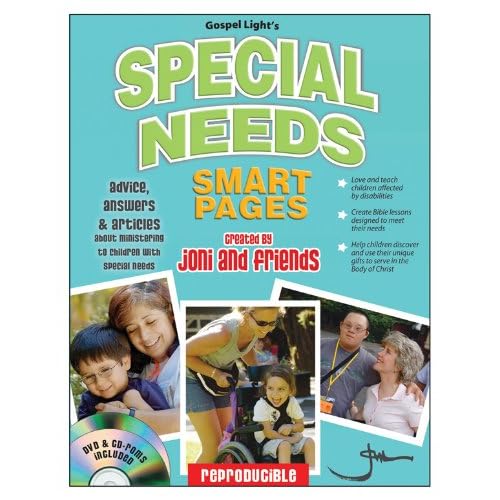
Title: Special Needs Smart Pages
Subtitle: Advice, Answers, & Articles About Ministering to Children with Special Needs
Author: Joni & Friends
Publisher: Gospel Light, 2009
# pages: 331
Extras: 2 discs with printable resources and videos

What I like: Comprehensive (if you're looking for something practical, it's probably in there). The usefulness of the included discs.

What I don't like: More program- and character-driven (moralistic) than Gospel-centered. Info overload makes it hard to find the truly great stuff in the midst of a lot of good or just okay content and may do a disservice to new special needs ministry volunteers (even I get overwhelmed unless I'm approaching the book with a specific need). And, this is picky, but I'm not a fan of the title.

Best for: Those who already have a vision for special needs ministry but who need practical tools to support it
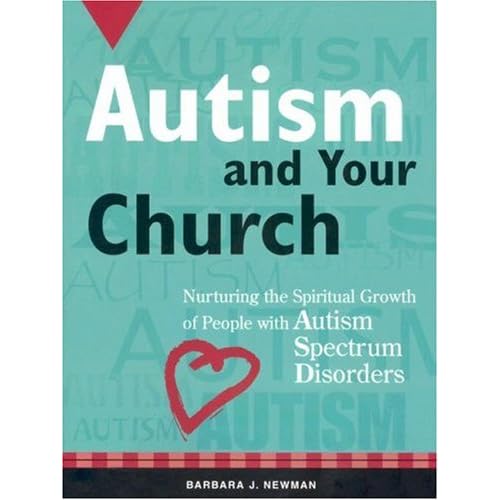

Subtitle: Nurturing the Spiritual Growth of People with Autism Spectrum Disorders
Author: Barbara J. Newman
Publisher: Faith Alive Christian Resources, 2006
# pages: 136

What I like: Readability (unlike the others I've listed which are more like toolkits than books). Vivid analogies. Universal usability (in other words, it's autism-specific but much of it could apply to most other special needs). Simple ready-to-use forms in appendix. Straightforward title. Strong use of personal stories.

What I don't like: Advocates for an IEP-like form for church that she calls the Individual Spiritual Formation Plan (IFSP); I think this may create extra paperwork and communicate the wrong message to parents (who may expect the same types of settings and services at church as at school even when that's not appropriate). Once again, more program- and character-driven (moralistic) than Gospel-centered.

Best for: Churches wanting to welcome families with children who have autism spectrum disorders, especially if no one at the church knows much about autism; also good for other special needs (not just limited to autism spectrum disorders)


Subtitle: A Practical Guide to Including Children with Disabilities in Your Church Ministries
Authors: Malesa Breeding, Dana Hood, & Jerry Whitworth
Publisher: Cook Communication Ministries, 2006
# pages: 143

What I like: Begins with the groundwork that salvation belongs to everyone, whereas many other guides begin with the premise that we are all created in God's image (which is true, but not as central to why we do what we do. The image of God is why we shouldn't exclude anyone with special needs; the hope of salvation is why we should include them in meaningful ways). Three authors allow for more voices and pooled knowledge. Great forms integrated into the text. Love the title.

What I don't like: Forms aren't designed to be easily copied from the manual and used in ministry settings due to formatting issues (but this doesn't bother me because I like to make any forms our own anyway, with our logo and our wording). Also could provide a little info overload, but not as much as Special Needs Smart Pages.

Best for: Those engaged in children's ministry


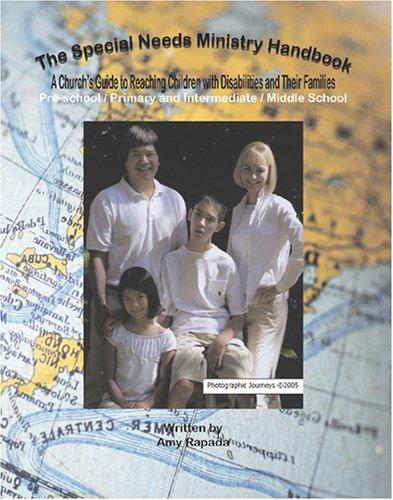
Subtitle: A Church's Guide to Reaching Children with Disabilities and Their Families
Author: Amy Rapada
Publisher: CGR Publishing (a self-publishing print-on-demand group)
# pages: 179

What I like: Provides 31 weeks of biblically-based object lessons for a special needs ministry class (totally 80 pages).

What I don't like: Obviously self-published (formatting issues, typos, ppt slides as images, smileys, and so on). Presents the church as God's house rather than God's people. Overemphasizes the usefulness of special education professionals (making them sound like a must-have in every church rather than a nice-to-have). Proposed mission statement seems somewhat secular, makes no mention of Jesus, and takes responsibility for more about the child's development than the church should. 

Best for: Someone who is already well-versed in special needs ministry and/or has another resource on hand who is in need of good concept lesson/center ideas and who is willing to overlook the lack of professionalism


There's also a guide called The G.L.U.E. Manual that I'm not personally familiar with. Considering that at $40, it's more than double the price of the other manuals (except the one from Joni & Friends, which offers a wealth of resources on the discs to justify the extra cost). I need to know more before I'm willing to purchase it, especially now when church budgets are tight. It is written by Barbara Newman, who wrote the autism book mentioned above, so odds are good that it's a solid resource.

And, finally, Key Ministry offers free resources and support to churches. Go to their website to find out more! My church is using some of their respite-related materials this fall.

What other special needs ministry books do you love, other than those I shared this week?

to grandmother's house we went

Or, more precisely, to Nana's house. Because my grandmother thought "Grandma" sounded too old lady-ish and opted for "Nana." (Which I think sounds waaaaaaaaaaaay more old lady-ish, but whatev. But, for the record, I will not be "Nana" to any grandchildren who might be in my future.)

After lunch with her and my dad, we swung by TJMaxx. Lee and I misunderstood the suggestion to pick out an outfit for each of the kids, assuming she would be buying it since she asked us to do so. Um, no. But by the time we realized that, my daughter - who already has enough clothes to cover half of Africa - had fallen in love with a new outfit. And Robbie had found a dinosaur outfit.

And so it goes.

{Thank goodness it was TJMaxx and not some fancy schmancy store.}

But she is darling in her new getup, don't you think?


And, yes, in case you're wondering, it is a size too big. She is indeed holding the skirt so it doesn't fall off.

And her little brother? Well, he wasn't changing. Not even for a dinosaur outfit. Because when he put his button-down shirt on that morning, he smiled, looked up, and said, "Mommy, I look good. I look real good. I wearing buttons like Daddy."

Melted. my. heart.


And he loves big sis so much, often following just like this.


I can understand, though, Jocelyn is a pretty cool kid.

I love Nana's yard. I did as a kid. I do now.


Especially because the lighting and colors show up so nicely on film.


Oh, and the scrape on Robbie's chin? He woke up with it.


We have no idea how it happened. It's kind of like when that psycho chick Michelle woke up with a black eye on the last season of The Bachelor.


(Um, yes, I did just make that reference. Don't worry, I'm hanging my head in shame already. No need to mock me any more than I'm already mocking myself. I had a moment of weakness once a week during that season. Thankfully this summer it's The Bachelorette, which I never like as much. And which is about one of my least favorite girls from last season, so the temptation factor is muy low.)


Now back to my children. Aren't they darling?


And doesn't this just make you want to have a swing like that in your yard?


But they weren't content to stay there.

And Robs is following. Again. <3


And then taking off on his own. Watch out! It's TurboRobs!


Have I mentioned that I love this swing?


I don't know what Lee just said before he took this picture, but it must have been funny!


And I have no idea what was going on here.


I love this shot, though. (Not the crazy one above, the cute one below!)


(Yes, we did bring Napoleon. No, we are not those crazy folks who think that it's appropriate to bring a dog with you anywhere. Those folks annoy me. We just bring ours where he's invited. And Nana loves him.)


I love my fur-son.


And, of course, I love my human babies too!


<3

A must, must, must read: Wrestling With an Angel by Greg Lucas

On Monday, I asked for prayers for Louise Tucker Jones and reviewed a book she contributed to, Special Needs, Special Ministry. Yesterday I told you about my favorite special needs ministry book, Same Lake, Different Boat by Stephanie O. Hubach. And I promised to tell y'all today about the disability-related book that I think belongs on every Christian's bookshelf, whether or not you're involved with special needs ministry.

What book is that? Wrestling With an Angel: A Story of Love, Disability, and the Lessons of Grace by Greg Lucas. It is a small book and an easy read, but it is the most powerful one on my shelves (except, of course, the Bible).

While it is a story about a man's love for his son with PDD-NOS (pervasive developmental disorder - not otherwise specified, which is part of the autism spectrum of disorders) and other special needs, I wouldn't describe it as a disability-focused book. It's about grace. It just uses the author's experiences as a parent to share poignant truths about the gospel.

Even the arrangement and titling of the chapters is all about God's grace:
  1. Break | Equip 
  2.        Grace breaks us with affliction in order to equip us with comfort and compassion
  3. Display | Reveal 
  4.        Grace displayed our sin as in a mirror, but reveals the cross as through a window
  5. Routine | Surprise
  6.        Grace surprises us with God's presence in the details of our daily routine
  7. Opposition | Humility
  8.        Grace humbles us by crushing our pride through humiliation
  9. Gifted | Saved
  10.        Grace saves us by freely and undeservingly giving what we need to be saved
  11. Satisfied | Waiting
  12.        Grace satisfies our heart with answers to prayer while we wait for the ultimate answer
  13. Darkness | Rescue
  14.        Grace pursues us into the darkness of our hopelessness carrying the rescuing light of the gospel
  15. Protected | Imperiled
  16.        Grace protects us through danger, not always from it
  17. Released | Gripped
  18.        Grace peels back our fingers to reveal God's greater grip of grace on our fragile life
  19. Future | Present
  20.        Grace walks with us into the future, revealing the unknown darkness as the shadowing presence of        our Father
It's a superb book. Get it. Read it. Share it.

And, if I haven't convinced you already, watch this video of Greg and his family, which you might have seen on the Desiring God blog last week:

Same Lake, Different Boat by Stephanie O. Hubach

I had this book on my shelf for a while before I read it. I didn't know much about the author, and the subtitle, Coming Alongside People Touched by Disability, had me expecting it to be a book full of anecdotes about families with special needs.

I didn't know that Hubach leads the special needs ministry at her church or that she is the Special Needs Director for Mission to North America (Presbyterian Church in America). I was expecting a great book written by a mom of a child with a disability - which this is - but it offers so much more than I expected because of Hubach's varied perspectives. While one of the three parts is distinctly family-focused, the first provides a foundation for thinking about disabilities within the church and the last clearly and convincingly details what special needs ministry could look like in your church. See the section and chapter breakdown below:

Part 1: About the Foundations
1. On Truth: The Four Missing Words
2. On Identification: Same Lake, Different Boat
3. On Respect: Common Grace, Special Needs
4. On Relentlessness: Dante's Circles of Disability
5. On Restoration: Thy Kingdom Come

Part 2: About the Families
6. On Coming to Terms with a New Reality
7. On Negotiating a Path to Acceptance
8. On Living a New Normal Life
9. On Grappling with the Great Opportunity

Part 3: About Facilitation in the Church
10. On Hospitality: No Room at the Inn
11. On Belonging: Same Body, Different Parts
12. On Wisdom: Questions Every Church Needs to Answer
13. On Change: Revolution or Reformation?

Here's a great interview with her that gives a glimpse into the content of the book.

So why do I consider this the best special needs ministry book available? As Hubach outlines in the introduction, most books out there fall into three camps: (1) experiential (personal stories/reflections of living life with special needs), (2) motivational (rallying cries to engage in disability ministry), and (3) programmatic (manuals describing how to do it).

(Side note: I would suggest that there's a fourth too: (4) theological (simple exegesis or more systemic hermeneutics of scripture in light of disability). Sadly, though, books in this category tend to suggest that all present theological understandings exclude those with disabilities, arguing that we need to create an entirely new understanding of scripture framed around the issue of disability. I strongly disagree with that perspective. Our present theology isn't failing to include people with special needs; we, in our sinfulness, do that on our own. The gospel isn't lacking; our application of it is. We don't need new theology; we need right application of existing sound theology.)

This book is different. In her words, "it is the compilation of what we have come to understand is true as a result of actively engaging in the struggle" of "wresting with God and his Word, with the realities of family life, and with the all-too-frequent inadequacies of the broader Christian community's response" (p. 16). I am so incredibly thankful that Hubach was willing to write it, sharing the results of that wrestling in a authentic and useful way. She argues that we're not all in the same boat or each in completely different lakes but rather, as the title suggests, in the same lake on different boats, "essentially the same but experientially different" (p. 37).

Here are some nuggets from the text:
  • But the American Heritage Dictionary definition of what it means to identify with another is much broader than this. It reads: "To associate or affiliate oneself closely with a person or group." This definition does not necessarily imply comfort or identification that is easy - just identification that is purposeful. (p. 37-38)
  • Notice that the model for mutual reliance in Christ's church is more intimate that same lake, different boat. It is same body, different parts. (p. 41)
  • ...when we truly understand grace, we realize that the poor, the prisoners, the blind, and the oppressed are us. (p. 47)
  • In order to extend grace to others in relationship, we have to deeply understand our own need for it. You can't give grace if you haven't received it. (p. 48)
  • Our actions ought to declare, "You are incredibly valuable!" to everyone we meet. (p. 49)
  • When people see us acknowledge our frailties and intentionally engage others in the areas of their brokenness, we live out the gospel of grace in powerful ways. (p. 49)
  • Have you ever sensed that while lip service is given to the sanctity of human life, those who actually relentlessly uphold it in their daily lives are forgotten? (p. 58)
  • When healing is not in the will of God's providence, and help is not enough - and it never will be in this lifetime - then hope is always a present reality. (p. 75)
  • To enjoin itself effectively to the struggles of a family that is just beginning to navigate the waters of disability, the community of believers needs to understand what the family is experiencing and learn to identify what the family needs so that the church may respond to those needs in meaningful ways. (p. 84)
If you only have one special needs ministry book on your shelf, this is the one I would recommend.

Special Needs, Special Ministry by Jim Pierson, Louise Tucker Jones, Pat Verbal, and others

On May 16th, this was posted by Amy at The Inclusive Church on their Facebook page:
Many of you may be familiar with Louise Tucker Jones and her writing, as she is one of the true pioneers in the fields of special needs and children's ministry. Join me in praying for Louise's husband, who was diagnosed this past week with Pancreatic cancer. Louise, today we lift you up in prayer! (Yes, I have Louise's express permission to share and request your prayers).
And today I read these words on Lifeway Special Needs Ministry's Facebook page:
Our prayers are extended to Louise Jones and her sons. Louise's husband, Carl, passed away yesterday after a swift battle with pancreatic cancer. Louise and Carl helped start the special needs ministry at their church in Edmond, OK, and Louise frequently wrote for Special Education Today magazine.
I've never met Louise or her family, and you may not know who she is, but Amy's words are accurate - she truly is a pioneer in the field of special needs ministry. You can find out more about her work at her website here.

This week I'll be sharing some of my favorite resources, and I was planning to start with my two absolute favorites. Instead I'm saving those posts for the next two days. Today, in light of this news and as an encouragement to pray for her family, I'd like to share the first special needs ministry book I ever read: Special Needs, Special Ministry (For Children's Ministry), with contributions from Louise Tucker Jones as well as two other pioneers in this ministry area, Jim Pierson and Pat Verbal.

It contains a balanced mix of practical how-to and thoughtful why-to do special needs ministry. Because it is co-written by several folks, it does have a somewhat disjointed feel, and I certainly had some chapters I liked more than others. All in all, though, it was instrumental in setting the stage and getting the ball rolling for much of what we are doing now at our church.

Here's what you'll find:
  1. Why Your Church Needs a Special Need Ministry by Pat Verbal
    • This is one of the foundational chapters for the whole book, running the gamut from dispelling excuses against special needs ministry to providing a brief biblical foundation for it.
  2. What Do Families With Special Needs Need? by Mary Ann McPherson
    • She does a solid job of sharing her personal experience and offering more universal suggestions for supporting families that may or may not have the same needs as hers does.
  3. The Special Needs Ministry Launch Countdown Checklist by Pat Verbal
    • Here, once again, Pat is strong with the biblical support. 
    • My favorite lines were those that she used to "check your motives." She warns against the motivation of pity (because it doesn't give the passion necessary to sustain this kind of ministry), of guilt (because the guilt will be gone once a program is in place, and you may not follow through with it), and of your own child's needs (because you'll only be involved in that ministry until your child ages out of it, and it will need leadership that will last beyond your tenure there). The right motivation? Love.
  4. Case Studies: Special Needs Ministries in Real Churches by Louise Tucker Jones
    • Louise did a great job here of presenting different models across various churches and denominations. This is so incredibly helpful because many of my suggestions are rooted from being at a large Southern Baptist church that is blessed with a number of volunteers who have backgrounds in special education. I realize that our realities aren't the same as every other church, so I try to take off the blinders created by my own weekly context, but it's great to hear about what other churches are doing.
  5. First Steps for Launching a Children's Special Needs Ministry by Jim Pierson
    • So practical. And so very, very good. Jim is one of my heroes in special needs ministry. In this chapter, he does a great job of laying out the initial steps to beginning a special needs ministry.
  6. Getting the Word Out About Your Special Needs Ministry by Pat Verbal
    • Pat walks through ways to communicate with three audiences: your church leadership, you church membership, and your community. This is the go-to chapter for me right now, because our ministry isn't too far into this. Some aspects are very well-known, and others simply aren't. I'm not using all of her tips, but they helped generate some ideas of my own.
  7. Recruiting and Training Volunteers by Pat Verbal
    • Good tips here, but not the strongest chapter in the book.
  8. Case Study: The Life of a Special Needs Ministry by Louise Tucker Jones
    • Building from her previous chapter, Louise shares how the ministry at her church began and grew.
  9. Evangelizing Children With Special Needs - And Their Families by Pat Verbal
    • I've heard it said that you can judge a family's priorities by their finances. Pat writes, "If someone were to judge a church by its programming, it might be easy to decide that in the minds of some churches, special needs children aren't part of the group Jesus came to reach." Ouch, but true.
  10. How to Partner With Community Agencies by Pat Verbal
    • In the USA, the secular community has often times done a better job than the church in meeting the needs of people with disabilities. This chapter is helpful for considering partnerships with those outside of the Christian community. (This chapter may be limited in its usefulness for those outside of the USA, though. In many other countries, neither the government nor secular groups have provided support for or shown love to these families. If you're in that situation, you have the opportunity to lead the way, which is what the American church should have done in the first place.)
  11. Case Study: The Wrap-Around Model - A New Opportunity for Children's Ministries by Larry Shallenberger
    • Perhaps this chapter was more revolutionary in 2004 when the book was published, but I didn't really see a novel approach here. What Larry suggests is essentially that we ought to be individualized in our approach instead of creating one size fits all programs and that we need to holistically support the family rather than isolating the child's needs and strengths.
  12. Facility and Liability Considerations by Pat Verbal
    • Our church meets in an old hotel building, which means a lot of this didn't apply for us (i.e. the hotel was designed to be accessible, we have chairs in our worship center - which used to be the hotel ballroom - instead of pews so wheelchairs are easier to accommodate for us, and so on). For most churches, though, the facility considerations are different, and Pat's guidance is great.
    • The liability concerns part of this chapter could be a launching pad to more conversations, but - at only a couple pages - it provides just enough to get your started. You and your team will need to fill in the rest. (One way we're doing that right now is through conversations with other churches about their policies and forms.)
  13. Sermons for Your Pastor by Jim Pierson
    • Jim provides four outlines for a devotional or sermon. These could be presented to others or just used for personal reflection in your ministry.
  14. Special Needs Heroes by Larry Shallenberger
    • These reproducible bulletin inserts each provide biographical information, a passage to ponder, a prayer, and tips for further exploration. The individuals features are Billy Graham (Parkinson's disease), Don Bartlette (physical disability, speech impairment due to untreated cleft palate), Dave Dravecky (cancer, amputation), Dennis Byrd (spinal injury), Frank Peretti (cystic hygroma), Ginny Owens (blindness), Heather Whitestone McCallum (hearing impairment), Joni Ereckson Tada (quadriplegia), Pihl Keaggy (missing one finger), and Rick Warren (allergy to adrenaline). While these were good, they primarily focus on physical limitations, and - if there is ever an updated version released - I would love to see a hero with an intellectual disability, autism, or ADHD.
I do want to note that this book doesn't consistently employ person-first language. And its strength - the variety of perspectives - is also its weakness because it can seem scattered from chapter to chapter. 

As a primer for special needs ministry, though, it was a great tool for me. Tomorrow I'll share my favorite special needs ministry book, and Wednesday I'll share the one that I think needs to be on every Christian's shelf, whether or not they are involved specifically in this kind of ministry.

Please join me in praying for Louise Tucker Jones and her sons and in praising God for her ministry to me and so many others.