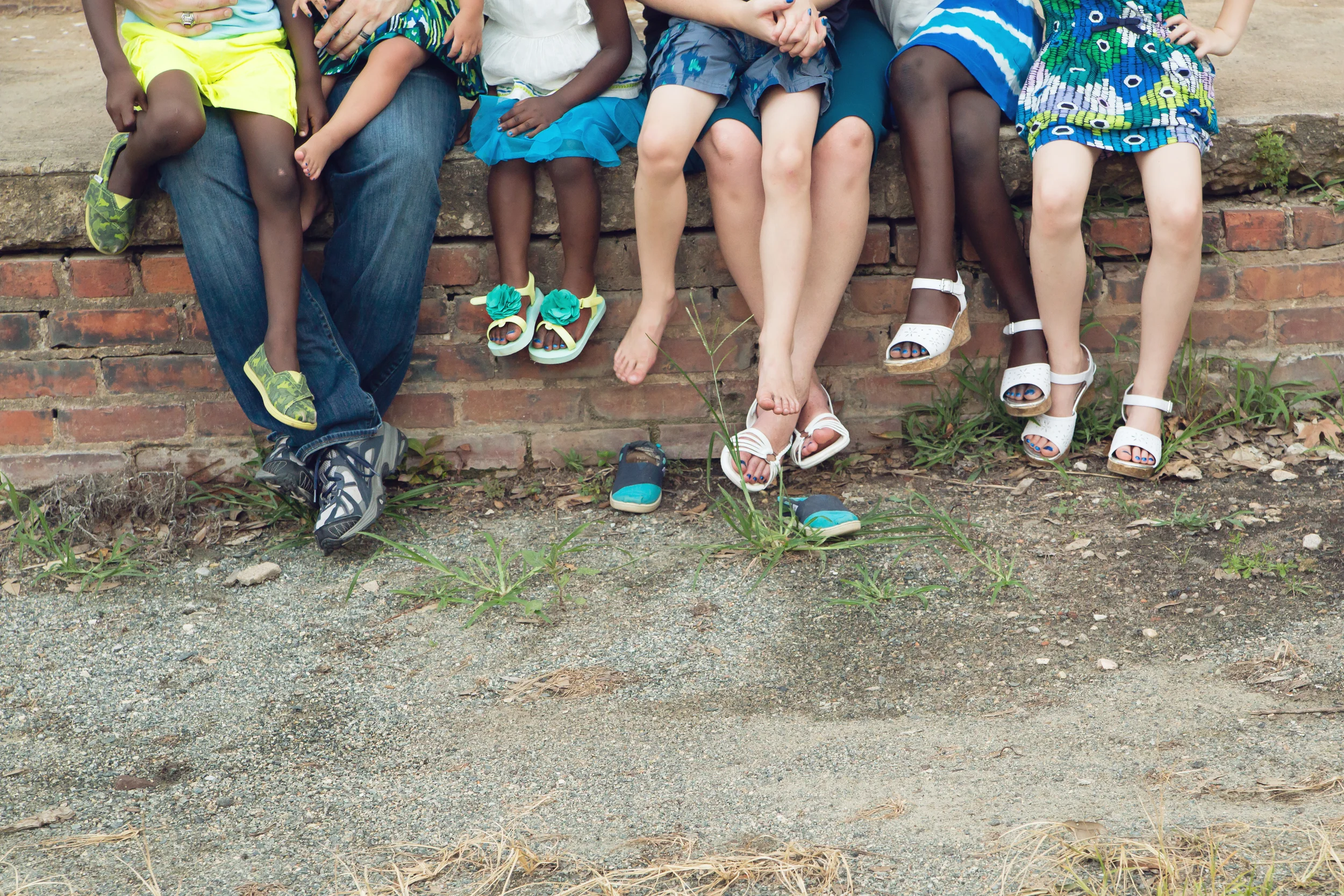
Fridays from the Families: Invisible

title: No66 19 mar 09 Invisible
photographer: mcfarlandmo
Our guest today is Kimberly Lavoie, the mother of a seven year old daughter with PDD-NOS and three-and-a-half year old twins. She writes about issues of special needs parenting and faith at The Simple Life. Thank you, Kimberly, for letting me share this with our readers today!
 
It is a rare Sunday that our family worships anywhere other than our home church. We attend a small church, and my husband and I are both heavily involved in lay ministry, so we try hard to be there each Sunday – often planning trips to leave Sunday after church and return Saturday night.

Last weekend we were visiting with some dear friends and didn’t have to be at our church, so we visited their church. It is larger than ours with a well-organized children’s program. I mistakenly thought my oldest daughter would like being in Sunday School class with more kids her age. Maybe I didn’t prepare her enough, or maybe she was too anxious from all of the other changes to routine. For whatever reason, she balked and started saying she wouldn’t go to Sunday School before we even left our friends’ house. Sometimes she does this at home too, so we ignored her protests and calmly drove off to church and dropped her twin siblings at the preschool department. I convinced the child to come see the Sunday School room and meet the teacher before making her final choice. The teacher was doing some warm up activities with early arrivals, so it took some effort to catch her eye. She asked my daughter’s name and grade in school, then assured us we were in the right place…still seeming a little confused as to why there was any hesitation. I asked her to explain what they would be doing in Sunday School hoping that one of the activities would grab my daughter’s attention and entice her into the room. No such luck. We said goodbye to the teacher and went to find our friends in the worship center. She seemed relieved and I decided maybe this was the better choice if she was really that anxious about it. We walk a fine line with the child in church – too bored or too stimulated (by anxiety or excitement) – either way can lead to a meltdown. I knew I could keep her engaged somehow during church; dropping her against her will in a new situation was playing with fire.

As we settled into our seats I noticed with my peripheral vision a young man sitting a few rows behind us. With a brief glance I could see that he had some special needs, too. There was an older woman sitting with him to give him support. I didn’t sit and study him or his caregiver, but it was obvious that they needed understanding and care. It seemed he was perhaps non-verbal as I heard some vocalization later in the service that was indistinct, though probably entirely understood by his companion. Meanwhile, my daughter was doing her best to behave. Sandwiched between mom and dad, she buried her face into Daddy’s backside while we were standing to sing. I decided she needed some sensory input, so I sat next to her and squeezed tightly giving her some pressure on her arms, legs, and even on her head. This seemed to calm her down. She enjoyed the music, though we didn’t know most of the songs. During the sermon I found her some paper and a pen, and she doodled away for the rest of the service. We saw the young man later being pushed in a wheelchair by the same woman. I smiled at them to try to communicate my empathy.

I keep pondering this whole experience – while I could see with a glance that the young man who sat behind us needed special care, our family’s need for the extra measure of support and encouragement went unnoticed. I don’t want to level any sort of complaint at our host church. They had no way of knowing our situation, which is my point. It’s more that I want to draw a lesson for my own ministry and others. We may never know which family needs that extra smile or reassurance. We may not know who needs some encouragement or understanding. I hope I am always open to listen, and more importantly I want my eyes to be sensitive enough even to see the invisible.

Special needs ministry policies: Start with the WHY

This post is part of a series on special needs ministry policies. Please see yesterday's post for a little more context: Your special needs ministry policies are worthless if they only live on a shelf.

When someone asks about policies, they're usually asking about how our ministry works - what we do, what our procedures are, how we handle certain circumstances. However, it is just as important – for everyone on your team, from staff to volunteers and even to yourself – to know why you’re doing what you’re doing. What’s the point? What’s our mission? What do we want to accomplish? What does the Bible have to say about this? What qualifies as a “special need” anyway?

You need policies, but you also need a purpose. That's why our policies are called the Access Ministry Guidebook, with the subheading Purposes, Policies, and Procedures to Enable Ministry. The "how" aspects of your policies do matter, and I’m working on many of those pieces right now for our guidebook. We do need to document what the plan is when a new family arrives and how to handle bathroom needs in special needs ministry settings. We do need to outline how to handle common issues. We do need to define rations of adults to children in various settings. All those "how" elements do matter. If you only include the what and the why without the how, then you'll have a concept with no practical application. 

Our policies start with the what and the why and then dive into the how. The first five sections are listed below and linked to previous posts in which I discussed the topic.
  1. The church’s mission/vision statement. My church has placed a great deal of trust in me as I lead Access Ministry with my husband. As a reminder that we operate within our church body and as part of that larger vision statement, we put that in the forefront. Because we're technically part of what we call "family discipleship ministry" at our church, we also have included the purpose statement for that ministry area. 
  2. The special needs ministry mission statement and goals. We have tweaked this a little from when I posted it, but it's still close to what you'll find here.
  3. The biblical foundation for special needs ministry. I usually put this first in any communication we have, because what the Bible has to say is far more important than what we've set as our mission statements. However, we've found that (a) it helps for our folks to have a little context for why these verses fuel our ministry and (b) that when verses are listed first, many people skip past the verses to find the meat of the guidebook (overlooking the fact that the meatiest parts are those verses!). That's why the biblical foundation is section three in our guide. It isn't exactly like this post, but that's one of the places we started from. Also, you might want to check out my Scripture Saturday posts in which I post verses related to special needs ministry.
  4. Clarifying note: Ministering with NOT ministering to: The wording of this post is very similar to the wording of our policy on this.
  5. What are “special needs” anyway? I realized that many of our volunteers were asking this question. See below for how we've answered it.
Defining special needs can be tricky. Here’s the draft from our guidebook about that topic:

While the educational definition of disability includes 13 handicapping conditions and the federal definition for adults is even broader than that, we aren’t concerned with every one of those categories. What we do care about is people, and we primarily focus on those disabilities and special needs that could hinder an individual’s involvement in our church body. For example, we need to know about food allergies, particularly for those who are too young to protect themselves, because we do serve snacks and other food at times and we want to keep individuals with allergies safe. If an individual’s mobility is limited in some way, then we wouldn’t ask him or her to climb the stairs and we would want to be intentional about involving him or her during game times or outside play times instead of, for example, parking the wheelchair in a corner and ignoring the person. If a disability impacts a person’s behavior or ability to learn, play, or interact with others, then we may need to make some accommodation or modification for their involvement in our church.

Many special needs have names – like autism, Down syndrome, seizure disorders, cerebral palsy, and others. While it is helpful to know those names, it is more important to know the individual. Each label is an attribute of a real individual created by God and not the defining characteristic for that person.
You'll see that I answered the question and sidestepped it all at once. Why? Well, the definition of "special need" in a church setting can vary depending on the context and stage. For example, a child with Down syndrome at our church - I'll call him "Jeremy" - is in elementary school and needs a one-on-one buddy to support him in his class; without that support, there would be barriers to his involvement in class. When Jeremy was two, though, the developmental differences between him and his same-aged peers weren't significant; Jeremy didn't have any barriers to involvement then, so he didn't need much extra support from Access Ministry. On the other hand, we have another elementary student who has Down syndrome and does just fine in her grade's class without any support; even though she's older than Jeremy, her needs are different. You see, it's not the disability label that requires support; it's the needs of the individual.

Tomorrow I'll be sharing a fantastic guest post with you (so excited!), and next week I'll dive into the "how" parts of our guidebook.

Finally, if you're thinking, "wow, I would love a copy of this Access Ministry Guidebook!" ... be encouraged! As soon as it is complete and has been reviewed by some colleagues, I'll be sharing it here at no charge. I would love to help equip other churches - your church, perhaps! - in special needs ministry. I'm willing and eager to share anything we're learning at Providence to help other churches.

~+~
And a couple of quick logistical notes: 
(1) I've added the option to subscribe via email. I've always had a feed which provided this option, but I recently realized that it wasn't a simple process to subscribe, especially if you're not tech-savvy. If you want my posts to come to your inbox, enter your email in the box on the right, just under my picture and bio. You'll have to complete a couple of additional quick steps after that, but it's a painless process! 
(2) I'm thinking about adding one book review - related to special needs ministry - every week or every other week. I think it could be helpful, but I have a few concerns. I would LOVE to get your input on any/all of these:
  • I am critical of several of them - though not all! - and I don't want to become one of those ministry bloggers who tears others down with my words. I know I can disagree in a civil way, but is it a good idea?
  • I have been toying with the idea of writing my own book. Would it be in poor taste to publicly discuss other books? My concern is that I don't want any critiques to seem as if I'm just being critical so I can later say, "...and this is why you should buy my book." (Am I overthinking this?)
  • Currently I post the weekly round-up every Monday, a guest post at least a couple Fridays a month, and a passage from the Bible every Saturday, with Sunday as the blog's day of rest. Adding a regular book review would take one of the remaining days. Is it worth it?  
Thanks!

Your special needs ministry policies are worthless if they only live on a shelf.

I was trained as a teacher. My master's degree is in education, not in ministry or theology. The last policies I wrote weren't for a church; they were for effective goal-setting and instruction in special education classrooms taught by Teach For America corps members.

As such, I know that the field of special education is the most policy- and paperwork-heavy of any corner of education. This isn't because IEPs are fun. In case you don't know that lingo, it stands for Individualized Education Program, and it's a legal document that details the strengths, needs, and supports for each child receiving special education services. IEPs are useful because each child is unique, and the needs of each child with a disability are also unique. IEPs are necessary because kids with special needs haven't always been guaranteed the free and appropriate education that legislation now ensures them and because research shows that individuals with special needs are more likely to be abused and neglected than their non-disabled peers.

For the same reasons, it is useful to have policies for special needs ministry, regardless of how formal or informal your church and ministry are. And putting them in writing is crucial because no ministry should have any person as its focal point, except for Jesus Christ. If my brain holds all of our policies, then I am at the center of it. And I'm not enabling anyone else to lead or serve well.

However, formal policies won't help you if they're not used. Actually, they can make you more liable if something problematic, injurious, or even criminal occurs in your church, because a policy that is written but not followed shows that you knew better but didn't act on that knowledge.

Let me tell you about the first special education guidebook I wrote. It was a beautifully rich and detailed 189 pages. It answered questions that had been lingering in Teach For America practice but had never before been answered. I was incredibly proud of it, as was the vice president who managed my work. And? No one read it. It sat on many shelves. It lived electronically on several servers, rarely or never accessed. It was well-written and strategic and potentially useful.

Problem was, though, that its potential was never realized because no one used it.

Scratch that. I used it. I copied and pasted sections when the numerous emails came my way from program directors around the country, asking me how they should handle various situations. They typically asked about situations that were described in the guide, with questions that were answered there with words and diagrams and examples ... that few people ever saw.

Where did we fail? We focused solely on the guide, perfecting the policies. We put little to no effort in the roll-out. We didn't communicate its usefulness, and we didn't convince anyone that they needed to know what was in it. We knew that it was useful, and we mistakenly assumed that others would know that too, without having to sell them on it.

Don't write policies if you're going to make that mistake. Don't bother wasting your time if you aren't going to use them and if you aren't going to share them. If you have space on your shelves to spare, I can recommend several worthwhile books to fill it. (Or you can send me your bookshelves. Mine have books stacked two or three deep because I don't have enough bookshelf space!)

I will be offering tips for training along with each policy area I discuss in blog posts, so don't panic about having to figure that out on your own. Please understand that I'm not trying to scare you off. I just want you to understand from the beginning that I don't write policy or talk about it as a simple exercise. It matters far too much to leave it at that.

Your church should have a plan for welcoming people with special needs. But don't get confused: it's not the plan that matters. It's the outcome: welcoming people with special needs. A plan on paper can't do that; a plan in action can.

And, finally, any plan - on paper or in action - is powerless without Christ. The aim isn't to welcome people with special needs to show that we love the gospel. It's not even about the gospel first. It's about the gospel. Period. It's about loving Christ because he first loved us and loving others out of the love and grace we have experienced from him first.

And now I'd love to know if you have any specific policy-related questions. There's a lot of ground to cover here, but I wouldn't mind adding a topic or changing my planned order of topics if it would be a blessing to you. What would you like to know?

What I take for granted at church because my kids don't have disabilities

I had the privilege of guest posting on one of Key Ministry's blogs this week, Church 4 Every Child. Dr. Steve Grcevich is a physician specializing in child and adolescent psychiatry and President of Key Ministry, and I am humbled by his kind words at the beginning of the post because I have a great deal of respect for him and his team too. Here's the beginning of my post over there and a link to read the whole thing...

I just watched The Blind Side with my husband this weekend, but I already knew about one scene. I had heard about it from a sermon or two and read about it in at least one book. In it, Big Mike looks around his new room and tells Leigh Anne Tuohy, the mom of the family who welcomes him into their home, “I’ve never had one before.” She says, “What, a room to yourself?” And he says, “No, a bed.” As she walks away, tears in her eyes, it’s obvious that she has been faced with a reality that is starkly different from her own.

If I want to go to Sunday school or a worship service, I do. If I want to serve in a ministry on Sunday morning or go to our church’s monthly leadership training, it’s not a problem. I have a two-year-old son and a four-year-old daughter, and if I want to do those things, I just take my kids to their class or childcare. If we need a babysitter, we call the girls across the street, even occasionally allowing the eleven-year-old to watch them for short stretches.

Like Leigh Anne in The Blind Side, I don’t regularly think about what life is like for kids without beds as I place my son in his bright blue racecar bed each night. And I don’t think twice about bringing my children to church or calling a trustworthy young sitter to come over so my husband and I can have a short date.

Weekly round-up! {7/25/11}

Families increasingly shoulder caregiving burden. This describes a study about those caring for individuals with life-long disabilities, "caregivers reported feeling stretched financially and emotionally, with 1 in 5 indicating that a family member quit their job due to caregiving responsibilities and the majority saying that they felt tired or stressed some or most of the time." Can the church help them?

A friend of a friend will be releasing an e-book this fall about their son's autism diagnosis and the first year following it. The title is Speechless: Finding God's Grace in my Son's Autism, and I am looking forward to reading it! Here's a little more about it.

When I taught in Texas, "mental retardation" was the category in which a few of my students were classified for special education purposes. Last week Arizona joined the list of states changing the term to the less emotionally-charged and negatively-connotated "intellectual disability."

Here's a news blurb about exposure to secondhand smoke as a possible contributing factor to developing ADHD and other disabilities. I think it's important for those of us in disability ministry to pay attention to news bits like this (and, along these lines, the multiple reports I've seen lately about possible genetic and environmental links to autism), primarily because these issues matter to parents and family members and people with disabilities.I haven't linked to these sort of news blurbs and articles in the past, but I'll start doing so. One warning, though: I don't share these blurbs with parents, and I think you should be sensitive not to bring up any information like this is such a way that it could communicate "you could have done something to cause this disability." Trust me, that doesn't help. I've been on the receiving end of well-intentioned but hurtful suggestions that a change to my diet or habits might have prevented or could now reverse my rheumatoid arthritis. Even if it were true that I could have done something to avoid the disease, what good does that knowledge do me now that I already have it?

My friend Mike of Making Room and Special Needs Ministry shared these ideas of things that can "feed" a child's sensory needs.

The Coffee Klatch shared Temple Grandin's top five tips for parenting a child with autism. Items 1, 2, 4, and 5 are all useful for ministry leaders as well, though I would advise against #3 in most church settings.

I found out about Cassi through Amy at The Inclusive Church, and I am so thankful for that online introduction via her blog. This week Cassi shared some sample forms from her church's special needs ministry. So useful!

It warms my heart when friends read something related to disability and theology, think of me, and email, Facebook, or tweet me with the link. That's what happens with this one: 4 Things I've Learned about God through my Baby who was Born Blind

On a less encouraging note...
  •  The behavior of a man with autism at church was misinterpreted, and he was handcuffed and detained by a police officer. And neither the church leader quoted nor the police spokesman seem to think that they should have handled it differently or proactively learned about autism to be able to differentiate between suspicious behavior and the manifestation of a disability. Sigh. Read about it here.
  •  Read this thought-provoking opinion piece: Ignoring the disabled is the new racism
And, to close my round-up this week, here are some great stories from churches around the country: one that is in the running to receive funding to build an accessible playground that they will make available to the public, one about a camp - called Camp Able - run by the Episcopal Diocese of Southwest Florida, and one about the FACES of Autism camp in Georgia that I mentioned last week.

And one of our families at our church will be attending a Joni & Friends family retreat next week, and I'm looking forward to sharing their experiences with y'all once they return. I'm so excited for them!