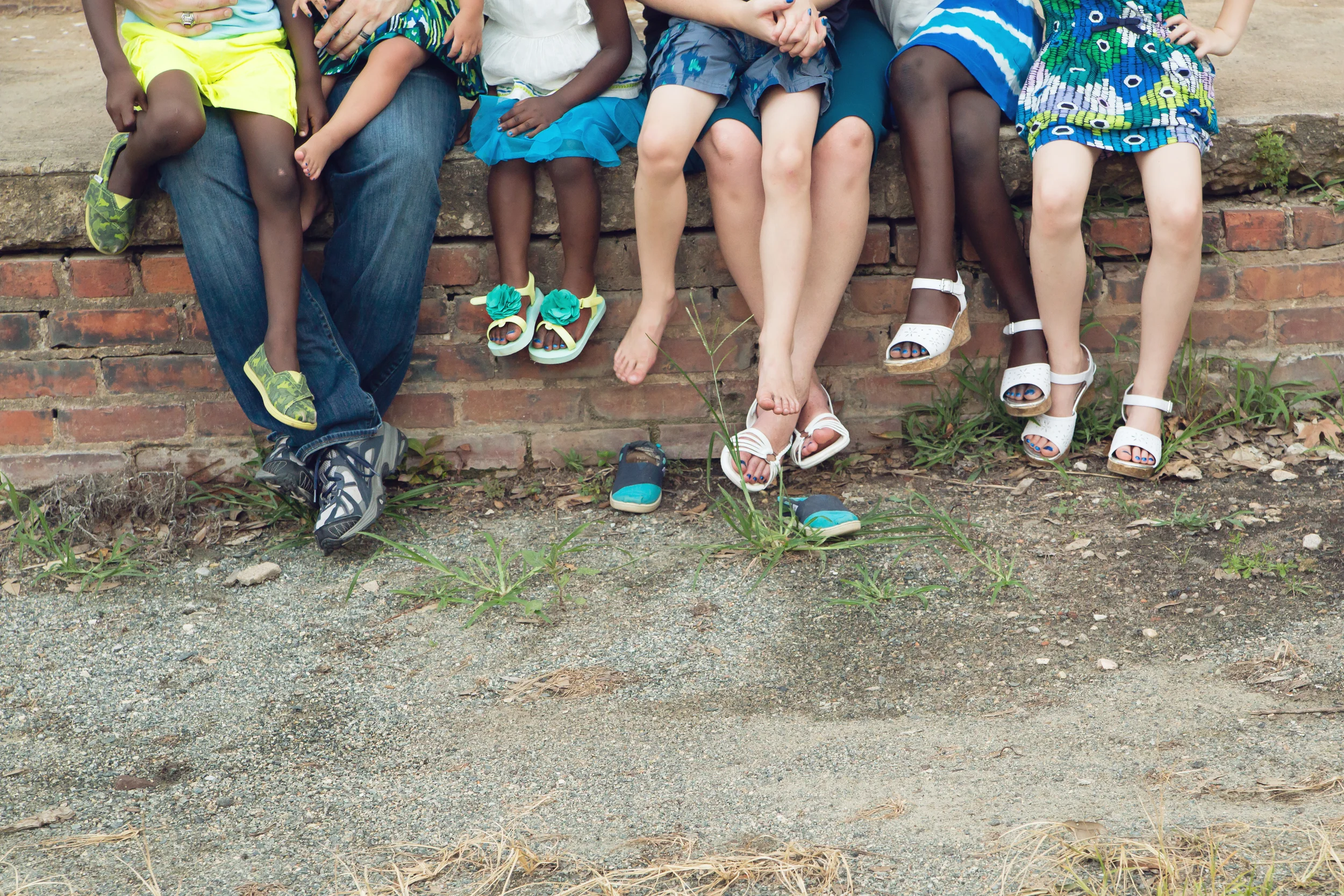
the beauty of normal interruptions

Over the past several weeks, when people have asked how I'm doing, I've said something like, "Well, we're good when we can stick to a routine. But then each week, we've had something major: a snow storm, the return of seizure for one kid, another snow storm, colds for three kids followed by colds for two the next week and a cold for the last one the following week, and so on. Then the routine is lost, and I gain a couple pounds by stress eating until the next hopeful start to the week."

Every week, it's been something. And every week, I've started optimistically, until the something happens that dashes my hopes for the week.

But I've realized something this week that has changed my perspective.

I'm a mom of six.

Okay, I knew that, but here's the life changing part...

Being the mom of six, every week is GUARANTEED to have something come up.

All of those somethings aren't interruptions to our lives or inconveniences to our routine.

They are our lives.

They are our routine.

Especially given how young our kids are and how many have special needs, interruptions aren't the enemy of normal.

They are the normal. 

Those pesky somethings that come up each week don't wreck the week, like I thought they did.

My response to each unexpected something is what makes the week - and the kids and my sanity - unravel.

Now that I expect those somethings to come, I can see them for what they are: opportunities.

Opportunities to show Christ's unconditional love to little ones who are hungry for it.

Opportunities to respond with grace to what the world sees as chaos.

Opportunities to declare the truth that each of our darlings are blessings and not burdens.

Opportunities to be reminded of how patiently God deals with me and to practice that patience to the ones closest to me.

Yes, it's hard. Yes, my plans always often fall apart. Yes, I'd really rather get the big girls to school on time than have to clean up a diaper blow-out and track down a lost jacket and console a little one who seems to constantly trip over her own feet and then end up pulling up to the school as the bell rang.

Yes, that last sentence was a description of this morning.

But I know a God who has done hard things - the hardest - for me.

When I view each hardship in the day as an expected opportunity rather than an unexpected interruption, I respond a whole lot more like the God I'd like to emulate as my children watch how I react and learn either wisdom or folly from my example.

I thought I was chasing normal and failing to grasp it, while all along I've been grumbling and missing the beauty of normal in each perceived inconvenience.

Yes, this new normal is beautiful.

Even in the midst of the "somethings" that crop up each week {or day}.


And? Sometimes the somethings are something wonderful, like a feisty two year old who loves helping Mama with the laundry. 


an accurate FASD diagnosis matters #preventFASD


We tend to look at behaviors rather than people.

All of us: teachers, parents, people in general.

When there's a diagnosis in the picture, sometimes we swing the other way: focusing on the diagnosis instead of the person.

Both are wrong.

People matter.

And that's why an accurate diagnosis of FASD matters.

Wait, what?

Let me explain: if we want to consider the needs of a person, we have to consider them holistically. To do so, the underlying causes of behaviors must be examined. In the case of behaviors related to FASD, an accurate diagnosis can help pinpoint the origin of the issues at hand.

Dan Dubovsky, who is the Fetal Alcohol Spectrum Disorders (FASD) specialist for the Substance Abuse and Mental Health Services Administration (SAMHSA) FASD Center for Excellence and who led the most recent MOFAS webinar, shared a story of a man with violent behaviors. Doctors discovered a lesion on his brain and subsequently removed it surgically. The violent behaviors disappeared. Prison or rehab or other negative outcomes wouldn't have worked for him. Any of those outcomes would have failed to address the cause of his behavior and would have failed him as a person.

Thankfully, his doctor saw him as a person first, not just a set of poor choices and violent behaviors.

FASD can often be misdiagnosed as adolescent depression, bipolar disorder, intermittent explosive disorder, autism (especially in cases in which verbal skills are average or advanced), reactive attachment disorder, traumatic brain injury, antisocial personality disorder, or borderline personality disorder. All of these misdiagnoses have a host of research behind them, detailing practice-proven interventions that can be beneficial for each diagnosis.

The problem is, though, that if the wrong diagnosis is assigned to a person, then the wrong underlying causes are assumed, which usually leads to the wrong interventions being applied.

In other words, misdiagnosing FASD can be just like putting a man with a lesion on his brain in jail to address his behavior instead of dealing with the lesion to address the cause. The wrong diagnosis for people with FASD can likewise lead to poor outcomes, like homelessness, educational failure, unemployment, addiction, broken relationships, drinking during their own pregnancies, and so on.

In preventing FASD, we tend to focus on a list of dos and don'ts, a list of behaviors to emulate and ones to avoid. But it's not about those lists: it's about babies who can be profoundly impacted by their mothers' drinking habits, who then become children who can struggle with sensory integration and attention and mental illness and medical disorders, when then become adults who - if never diagnosed correctly - have trouble fitting in with the rest of the world because they were never given the tools to do so.

But the good news? When prenatal exposure to alcohol is avoided, FASD can be prevent 100% of the time. When prenatal exposure to alcohol is known (or hypothesized, in cases of adoption - for example - when full medical history isn't available), then parents and professionals can look holistically at the individual and ask, "What does this person need to be successful?"

Because FASD is about the person, not the diagnosis.

I'll include more information about strategies and tips to answer that question in next week's post, as I close out this series of posts, all part of a sponsored campaign with MOFAS and Brandfluential. You can still register for the last webinar, coming up this Thursday and focused on the topic "Family Matters: Strategies for Successful Outcomes." 

living with cerebral palsy

As we made a list of special needs we'd be open to in adoption, CP - a group of neurological disorders that affect movement - wasn't on the list. We hadn't completely ruled it out, but we certainly hadn't ruled it in either.

But now? We can't imagine our lives without Zoe, and our love for her emboldens us to take on whatever else comes with her diagnosis.

For us, here's what that means:

  • MRIs to check brain development, particularly in the areas affected by PVL, her particular kind of brain damage. 
  • physical therapy twice a week. 
  • occupational therapy once a week. 
  • speech therapy once a week. 
  • check-ups with the neurologist and the physiatrist. 
  • fittings with the orthotist for leg braces and wrist splits. 
  • meetings with the early intervention program, which are now moving toward meetings with the school system as she nears age 3.
  • Botox injections (and possibly oral meds or surgeries in the future)

It means all that, but it also means:


We still don't know what the future holds for Zoe: if she'll ever live independently. if she'll continue to keep up with her peers in cognitive ability. if she'll walk. if she'll maim other children by plowing them down with her gait trainer.

you know, things like that.

But, if we're honest about our helplessness and God's sovereignty, we have to admit that we don't know what the future holds for Jocelyn or Patience or Philip or Robbie or Patricia either.

It might sound childish, but we still believe the words of the song we learned as kids. We trust that He holds the whole world - including our whole family and Zoe's whole brain, just as he shaped it - in His hands.

For that, we are thankful.


Zoe's getting botox {and not just because she's a diva}

Botox, most well-known for references in Hollywood and pop culture, isn't just for wrinkles.


Little girls who shouldn't be left alone with a Nutella sandwich can benefit too.

In the same way that Botox relaxes the skin to reduce wrinkles, when injected into muscles, it can relax the tension that's common in cerebral palsy to help Zoe's movement. In cerebral palsy, muscle issues are caused by injury to or the absence of certain parts of the brain affecting motor development; as a result, the brain sends the wrong signals to muscles - in Zoe's case, making them a lot tighter than they should be, so that she has to fight against muscle stiffness for every little movement. Botox blocks the chemical signals between the brain and those muscle groups, so the screwy signals don't get received by the muscles.

In other words, her brain will keep saying, "Tighten up!" and her muscles will put their fingers in their ears and shout, "LALALALALALA! I CAN'T HEAR YOU!" 

For our girl, it'll be the hamstrings and forearms this go-round, and we're waiting to hear back about the scheduling of her injections. Baclofen, an oral med designed to relax muscles, is on the table too, but we're thinking that a more focused - that is, muscle-group specific - treatment is best right now, given that her tightness is severe in a few specific places and more mild everywhere else.

Plus, she is quite a diva, so Botox seems fitting in other ways too, right?

{I wonder if they'll spare some for me...}

five things we should all know about FASD #preventFASD

I broke the news last week that one of our kiddos has been affected by alcohol exposure while in her first mother's womb. Those words are hard to type, but when the Minnesota Organization on Fetal Alcohol Syndrome (MOFAS) asked me to partner with them and Brandfluential in a sponsored campaign to raise awareness about fetal alcohol syndrome, I prayerfully decided this was the right time and right partnership.

I haven't had any alcohol for nearly a decade, for a variety of personal reasons. Most people assume I'm a complete teetotaler. That's not the case. If I'm honest, I'm a bit jealous of those who can enjoy the occasional glass of wine or martini.

So feel free to have one for me. Please. 

That is, unless you're pregnant or could be pregnant, which leads me to the real purpose of this post...

I wanted to start by disclosing my decade of personal prohibition as a disclaimer of sorts. For me, having a beer or other adult beverage while pregnant wasn't a consideration: not because I was pregnant, but because I simply didn't drink while not pregnant at that time.

My initial interest in fetal alcohol syndrome disorders (FASD) came from two places: (1) my experience as a special education teacher, with some students for whom prenatal alcohol exposure was a factor in their disabilities, and (2) my hope to adopt someday, as I learned that FASD rates were higher among adopted children than other children, with many diagnoses unknown before adoption.

Now, my interest is even more personal, as I love a child who was exposed to alcohol before she took her first breath.

The first of three webinars I'm promoting with MOFAS focused on the basics of FASD. Much of the info was new to me, while some was a review. Dr. Jeff Wozniak of the University of Minnesota drew from extensive knowledge, as a researcher, as a practioner, and as an instructor. He directs the Child and Adolescent Neuropsychology Clinic at the university, where he sees patients with a variety of neurodevelopmental, neurological, and psychiatric conditions, and he is the co-director of the University’s Fetal Alcohol Spectrum Disorders Program. Recently, he has extended his work in FASD to include treatment studies and is currently the co-principal investigator of a unique clinical trial targeting brain development in young children with developmental delays from prenatal exposure to alcohol.

In other words, if anyone is an expert in this field, it's Dr. Wozniak.

I know all of you aren't as nerdy about neurology as I've become, so I'll try to avoid too much medical jargon in this list of takeways. (If you want it all in full, the first webinar will be re-broadcast on February 25, and you can register and find more info here.)

five things we all should know about FASD

  1. It's 100% preventable. If women of childbearing age avoided alcohol whenever they are sexually active and not using birth control, then no child would experience the neurological effects that can come with prenatal exposure to alcohol on the developing brain. Why should we avoid alcohol before it's time to pee on a stick? Because...
  2. The most devastating neurological effects of FASD can occur in early pregnancy. Given that women don't know that they're pregnant for a couple weeks or even a couple months, depending on the woman, damage can occur by drinking before knowing about the little one growing inside of the womb.
  3. FASD is under-diagnosed. In recent decades, clinical diagnoses of other neurological disorders - ADHD, learning disabilities, sensory processing disorders, mental illness, and so on - have been on the rise. During that same period, women's alcohol consumption has increased, especially binge drinking. I'm not saying all of those issues are always related to prenatal alcohol exposure - of course not! But leading researchers in the field of FASD think that it may be the unrecognized underlying cause for some other disabilities. 
  4. No amount is proven safe, but binge drinking is the riskiest. Binge drinking, though, is defined as four alcoholic beverages over the course of two hours. And the amounts matter: one glass of wine in a balloon wine glass is actually two alcoholic beverages in quantity. One margarita at most restaurants contains three or four drinks worth of alcohol. I tend to think of binge drinking as what I did with red Solo cups of stuff we called PJ at frat parties back in college. (Don't judge.) But the amount I sipped at book club meetings in my first year of teaching would have qualified too. 
  5. As new research emerges, we can be safer for the coming generations. In other words, don't feel guilty if you didn't abstain from alcohol in previous pregnancies. My parents smoked cigarettes, including around us kids, as I grew up. (That said, I remember being so proud of mom when she kicked the habit while I was in upper elementary school!) We wouldn't do that now because we know it's not good for kids, but I don't expect my parents to feel guilty about the choices they made before research proved them unwise. 
So what do we do with this information?

First, I think doctors need to be having frank conversations about alcohol with all their female patients who are of child-bearing age.


Second, when we know better, we can do better.


~+~
The webinar series has one more event this coming Thursday. It is FREE, but it does require registration. This coming week's topic is the one I'm most excited about: Family Matters: Strategies for Successful Outcomes. I'll write follow-up posts for each - with my post for the second webinar coming next week - but if the last webinar is anything like the first two, it'll be way more helpful info than I can fit in one post. 

(Also, CEUs are available for educators, social workers, addiction professionals, and psychologists, so check that out if you're in one of those fields.)