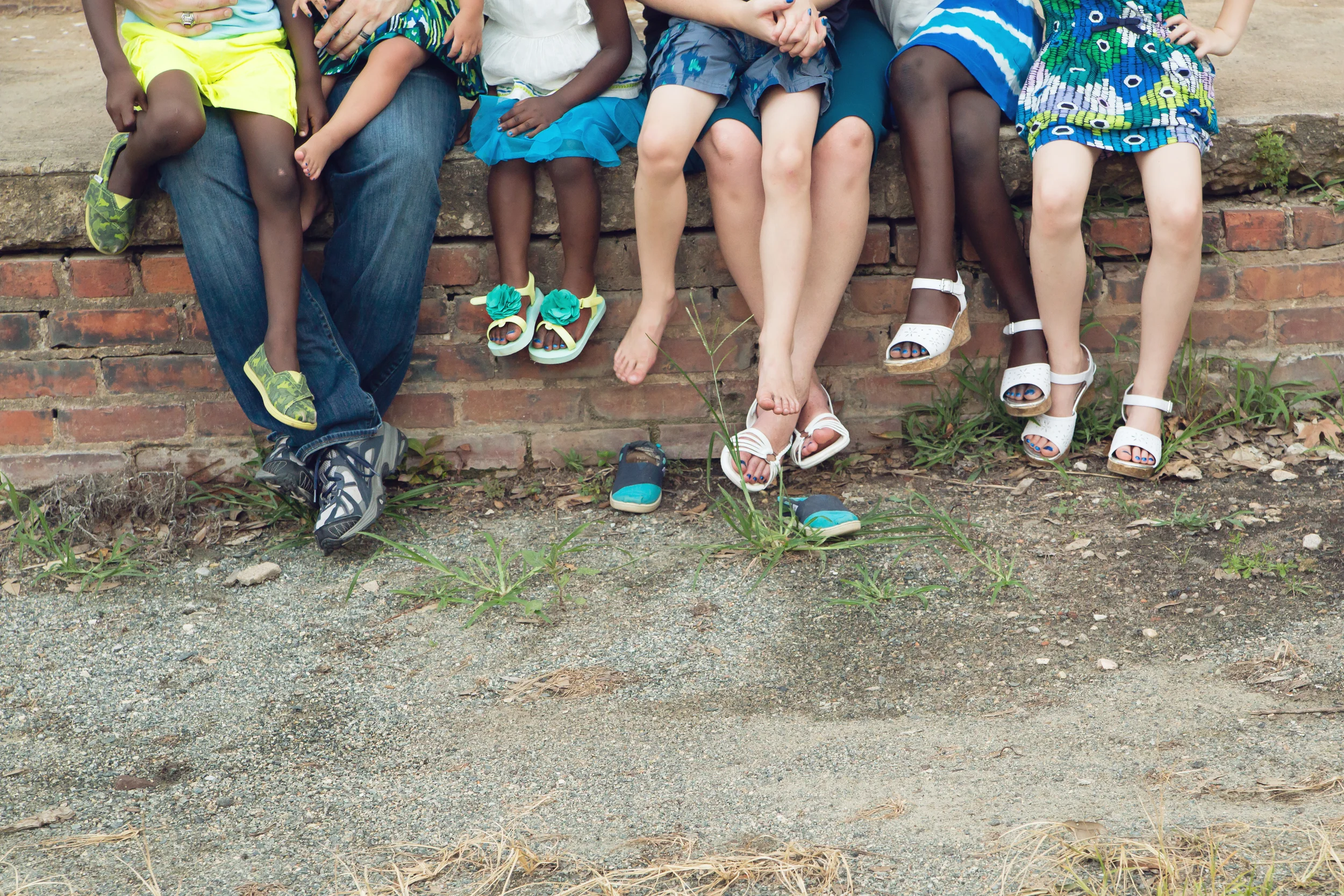
Adopting THREE siblings at once? You crazy?!?

Lee and I have always discussed sibling adoption as something we’d like to do, going back to our dating days.

Did we ever think it would be a sibling group of THREE after we already had three children, including one who only came home from Taiwan nine months ago?

No.

Nonetheless, we are ecstatic. Our hearts are bonded to these three precious ones much in the same way as we love Jocelyn and Robbie and Zoe. We can’t explain it fully, but this crazy plan to complete our family is so perfectly right for us.


It won’t be easy. We’ve weathered some hard things as a couple, and we expect this to be the hardest.

But?

Sibling groups wait and wait and wait for families, often having to be split up (which is what was going to happen to our three children in Uganda). In the case of our group, two children are younger than five, which is often the magic tragic age at which the odds of getting adopted drop. Even our six-year-old Ugandan princess is gorgeous, so perhaps her odds wouldn’t have dropped yet.

In other words, each child alone would have better odds of being adopted than the group.

That’s without factoring in the HIV+ status of one of them, which – while manageable and not risky for a family – is another dynamic leading to longer wait times to be adopted.

The odds are stacked against the adoption any sibling group, much less one with identified special needs.

Yes, sibling adoption will be hard for us.

Remaining orphans or being split up from your siblings after losing your parents?

That’s harder.
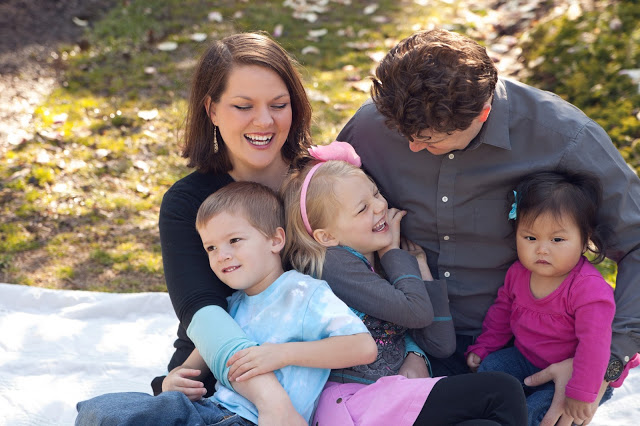
Isn’t asking for adoption donations just like asking people to pay your hospital bills after giving birth?

In a word: no.


In cases like our adoptions, our children are waiting. Zoe was waiting.

Primarily, they waited for someone who would love them no matter what. Zoe needed someone who would love her, no matter what her brain injuries would mean for her. (Oh, how we do love her!) Our three Ugandan darlings needed someone who would love them enough to look past the number of children, the diagnosis of HIV for one, and the difficult aspects of adoption in an impoverished country. (Oh, how we already love them!)

Before I say anything else: We are not saints. We are not heroes. We are not angels. We are not amazing.

When you pin any of those descriptors on us, it makes it harder. Because if I’m a saint or angel or hero, I can’t be a jerk or human or ‘fess up that sometimes this sucks. If you put us on a pedestal, then we’re too far off the ground to reach out when we need help. And we often need it.

You know what? All of us who adopt waiting kids – those who are older or have special needs – are ordinary people. And ordinary people rarely have $25,000-40,000 sitting around. (That first figure is the final cost for Zoe’s adoption; the second one is the estimated cost for this one.)

Praise God that between our savings and friends' donations we have $12,000 of our adoption costs covered, which leaves $28,000 left to go!

Grants are available. We’re applying for them.

We may take out a loan this time. That’s hard to admit, given that we’ve been thankful to only have a mortgage payment and nothing else in way of debt… but if you think of the long-term investment, adoption is worth adding a monthly payment to the mix (and my taking on extra freelance writing to pay for it).

Finding families who are willing to adopt waiting children in hard circumstances and afford it all on their own?

That’s rare.

Would it be better for our child who waited or our children who are waiting to keep waiting? Should they have had to play the adoption lottery, hoping that they would end up with the right combo of people who had the desire and the money? Furthermore, the Bible is clear: Christians are called to take on the cause of the orphans: some of us do that by adoption, others by caring for children until they can return to their birth families, and others by supporting all kinds of adoption, fostering, and orphan care.

In other words, fundraising allows other Christians to invest in adoption and thus heed the calling of scripture, even if they aren’t led to adopt. (Keep in mind that the early church was a community, not just a cohort of individually-sufficient people who shared the same God and holidays as the modern church can often be.)

When I gave birth to Jocelyn and Robbie in the hospital, we had a high-deductible health insurance plan. That meant we owed a big chunk of that deductible after their births, given that Jocelyn was a January baby and Robbie came in March, both early in the calendar year before we had accrued many costs toward our deductible.

What did we do? We saved in advance (as we’ve done for each adoption) and then if our savings hadn’t been enough each time, we could have arranged a payment plan. I know because the financial person brought us copies of that paperwork, assuming we’d need it due to such a high bill. (Thanks to our health savings account and Lee’s savvy money management, we were fine both times.)

You can’t get an adoption HSA, though. While our income is sufficient for living and giving to the church and other ministries and causes, we don’t have enough extra each month to come up with the grand total for this adoption or the last one.

We will willingly sacrifice where we can. We’ll continue to do that once our children are home, because really? We’ll have enough for everyone, but it’ll be tight and require a whole lot o’ creativity to live as a family of eight.

When we fundraise, we’re asking others to tangibly join us in saying that these kids matter.

Each dollar, each word of encouragement, each comment, each hug, each gift, each show of support in word or deed or donation… it speaks love to us.

Thank you.

Is it wise for you to adopt when your daughter receives government services for early intervention?

I blogged a few weeks ago about receiving income-based government services for Zoe’s therapy needs. Given that we can’t afford Zoe’s therapy without financial support via early intervention, is it wise to even consider adopting again? Can we really afford three more children?


Before I tackle those questions, let me explain a bit about how disability services work in the US. Take autism, for example. Medical insurance companies try to classify most treatments as “educational;” meanwhile, public schools say, “no, that’s not covered, talk to your insurance company.” As they go back and forth without getting a “yes” from anyone, parents are spread thin, fundraising at times for their children’s behavioral therapy.

These parents usually would have no financial problems if autism wasn’t part of their world. They would be as solid on that front as you are, if not more so.

The problem isn’t their money. The problem is the gaps in coverage and lack of options.

In many states, parents don’t have the option of buying an insurance plan that would cover their child’s therapy needs. Not even a higher cost plan. They just don’t exist.

For us, if we stay at three children or increase to six, we would need the exact same support for Zoe’s early intervention program. We have enough money to care for three more children, but that’s simply not enough to pay for the portion of Zoe’s therapy costs that fall outside of insurance coverage.

In other words, while our services are income-based, the focal point isn’t our income, in the way that food stamps, WIC, or other welfare programs are. The focal point is our child’s disability.

One of our children in Uganda has HIV. Because that’s a clearly medical need, the care for that child will be completed covered by our private insurance. Easy peasy.

Disability services aren’t treated the same way, largely because of quibbles between insurance companies and educational systems.

So can we really afford three more children in our family?

Yes.

(Our social worker and agency require that, actually. So does the US Citizenship & Immigration Services office. We wouldn’t be approved for adoption if we couldn’t. Money will be tight, but we have a budget and, thankfully, no debt other than our mortgage.)

Is it wise?

Once again, I say yes. Because, really, while early intervention is an income-based program, it’s not the same as some of the other programs out there that support a family’s ability to meet basic needs. Almost every family with a child who has a disability receives some level of government program for support, be it early intervention or special education or Medicaid.

If we were receiving other types of support and were unable to financially (and emotionally) care for three more children, our current adoption would be unwise.

That’s not the case, though.


Finally, is it wise to turn our back on these children when God, the source of all wisdom, “executes justice for the fatherless” (Deuteronomy 10:18) and directs His people to provide for orphans (Deuteronomy 24:19)? When He calls Himself the “Father of the fatherless” (Psalm 68:4-6) and promises to uphold them (Psalm 146:5-9)? When He defines unfaithfulness, in part, as “not bring[ing] justice to the fatherless” (Isaiah 1:23) and defines pure and undefiled religion as “visit[ing] orphans…in their affliction?” And when He reminds us that the concept of adoption isn’t an earthly one but a God-orchestrated one, that of His promise not to leave us as orphans (John 14:18) and of His adopting us as children of God through salvation (Romans 8:14-17, Galatians 4:4-7)?

When we’re called to teach God’s word to our “children, that the next generation might know them… so that they should set their hope in God and not forget the works of God” (Psalm 78), our willingness to not just share scripture but to apply it shows them that our hope is in God and that we trust in His works, even when that application means adding three more children to our family via adoption.

We know God is guiding us in this. And? Early intervention will happen either way for our Zoe, whether we bring home our three Ugandan children or not.

So, yes, it’s wise. It might be the wisest thing we’ve ever done.

(And the craziest.)

How have your adoptions been so fast? Aren’t you worried about ethics?

When we were approached about Zoe’s need for a family, our first questions were about ethics.

Same with these three in Uganda.

Why? Because we only want to adopt a child who needs a family. If anything unethical is happening – like coercion of birth parents or other family members or kidnapping or child trafficking – then the solution should be to reunite the child with his or her family. In that case, the child doesn’t need a family; he needs justice.

Interestingly, most of the Bible verses about earthly adoption talk less about child placement and more about justice. Caring for orphans can include adoption, but sometimes the just outcome is something different. I love supporting ministries that focus on more than just adoption in their efforts to care for children in need.

That said, reunification isn’t always possible. The justice for some orphans is adoption.

We all know stories of people who waited years to adopt a child. Some of my friends are still in the middle – hopefully nearing the end! – of a long wait.

Us? Zoe’s adoption took less than six months, from start to finish. Right now, it looks like this adoption will be fast-paced too. (Just got an estimate from our agency - it's looking like we might travel in August and come home with our precious ones in September!)


Adoption ethicists will tell you about red flags for adoptions. I’m thankful for their guidance, because I’ve learned questions to ask to determine which programs to trust and which ones to avoid.

Adoptions that are quick and easy? That’s considered a major red flag.

And it can be.

But long waits are frequently due to families waiting for a child to be born or made available who meets their criteria. (Or due to something else altogether, like long legal processes and bureaucratic disorganization.)

Adopting child who is waiting for a family, usually an older child, sibling group, or kiddo with special needs? That’s often - though not always - much faster.

In our adoptions, that’s been the factor accelerating the process. (Plus the timing with the country’s courts went in our favor with Zoe.)

Speed and ethics? Yes, they can go hand in hand in adoption.

They have in ours.

How do you do it all? My secret: Lee is awesome.

Seriously.


He loves Jesus.

He packs Jocelyn’s lunch every day.

He cooks most of our meals.

He does bedtime routines with the kids in the evening.


He comes home for lunch almost every day.

He makes me laugh.

He stays home with the kids when I have speaking engagements.

He walks the dog every morning and most nights.

He drives whenever we go anywhere as a family. (I abhor driving.)

He leads our church’s special needs ministry with me. (Oh, how it makes me fall in love with him all over again each time he advocates for one of our Access Ministry kids!)


He brings Jocelyn to school once a week so that I don’t have to juggle carpool and Bible study that morning.

He’s savvy with money.

He doesn’t complain when I need some time to myself in the evenings when he gets home from work.

He’s my best friend.

He’s handy around the house and all things technological.

He loves all kids, especially ours.

When I say, “This is crazy, but I was thinking…” he hears me out, knowing that I might be suggesting another adoption or simply considering painting our doors a bright shade of aqua.


I could say sooooooooooooooooo much more, but I’ll stop there.

 How do I do it all?

I don’t. 

We’re a team. Lee does a whole lot.

I am so in love with him.